The stark, dramatic beauty of the Norwegian fjords, often shrouded in the dim light of polar winter, became the stage for an extraordinary display of marine power and elegance. For weeks, photographic expeditions, led by renowned wildlife photographer Paul Nicklen, navigated the frigid waters in pursuit of elusive orca pods. The journey, characterized by challenging conditions and limited sightings, culminated in a breathtaking moment of unexpected exuberance, where a pod of these magnificent apex predators engaged in a feeding frenzy, culminating in a spectacular display of breaching and porpoising that defied the typically reserved behavior of Norwegian orcas. This event, captured through Nicklen’s lens, offers a profound glimpse into the complex lives of these intelligent cetaceans and underscores the importance of preserving their wild habitats.
The Elusive Giants of the Arctic Seas
Norway’s coastal waters are a vital feeding ground for a distinct population of orcas, often referred to as "resident" orcas, which primarily target herring during their migration. Unlike their counterparts in British Columbia, known for their acrobatic breaching, Norwegian orcas are generally observed to be more reserved, with leaping from the water being a rarer occurrence. This distinction makes the witnessed event all the more significant. The expedition, which had been meticulously tracking these pods for an extended period, faced the typical challenges of Arctic wildlife photography: low light conditions, unpredictable weather, and the inherent difficulty of locating and observing highly mobile marine mammals.
The period of observation coincided with the polar night, a time when the sun remains below the horizon for extended periods. This meant that daylight hours were limited to brief windows of twilight, casting a moody, ethereal glow over the landscape. The days were often described as "dark," with the sun’s appearance reduced to a fleeting "pink glow" around midday. This challenging lighting environment demands exceptional skill and specialized equipment from photographers aiming to capture clear, impactful images. The rough seas that frequently accompany these conditions further complicate the task of maintaining stable camera platforms and tracking fast-moving subjects.
A Dawn Patrol Transformed: The Moment of Spectacle
The turning point in the expedition arrived one morning, as the team followed a distant orca pod. Initially, the scene appeared quiet, with only the presence of large males being discernible. The expectation, based on prior observations of Norwegian orcas, was for continued subdued activity. However, an unseen trigger, likely related to a successful hunting endeavor, suddenly galvanized the pod.
"Then, one morning, as we were following a pod of orcas, something wonderful happened," Nicklen recounts in his field notes. The distant pod, previously appearing quiescent, began to exhibit signs of intense excitement and activity. This shift signaled a feeding frenzy, a crucial period for these animals to replenish their energy reserves.
The observation team, sensing the imminent spectacle, accelerated their vessel, carefully maintaining a safe distance to avoid disturbing the orcas. They moved at approximately 20 knots, a speed necessary to keep pace with the dynamic movements of the pod. The conditions, for once, were favorable. The water was calm, and the sky offered a rare palette of soft hues, with hints of orange and pink against a darkening horizon, all framed by the majestic silhouettes of the surrounding mountains.
A Symphony of Motion: The Orca’s Aerial Display
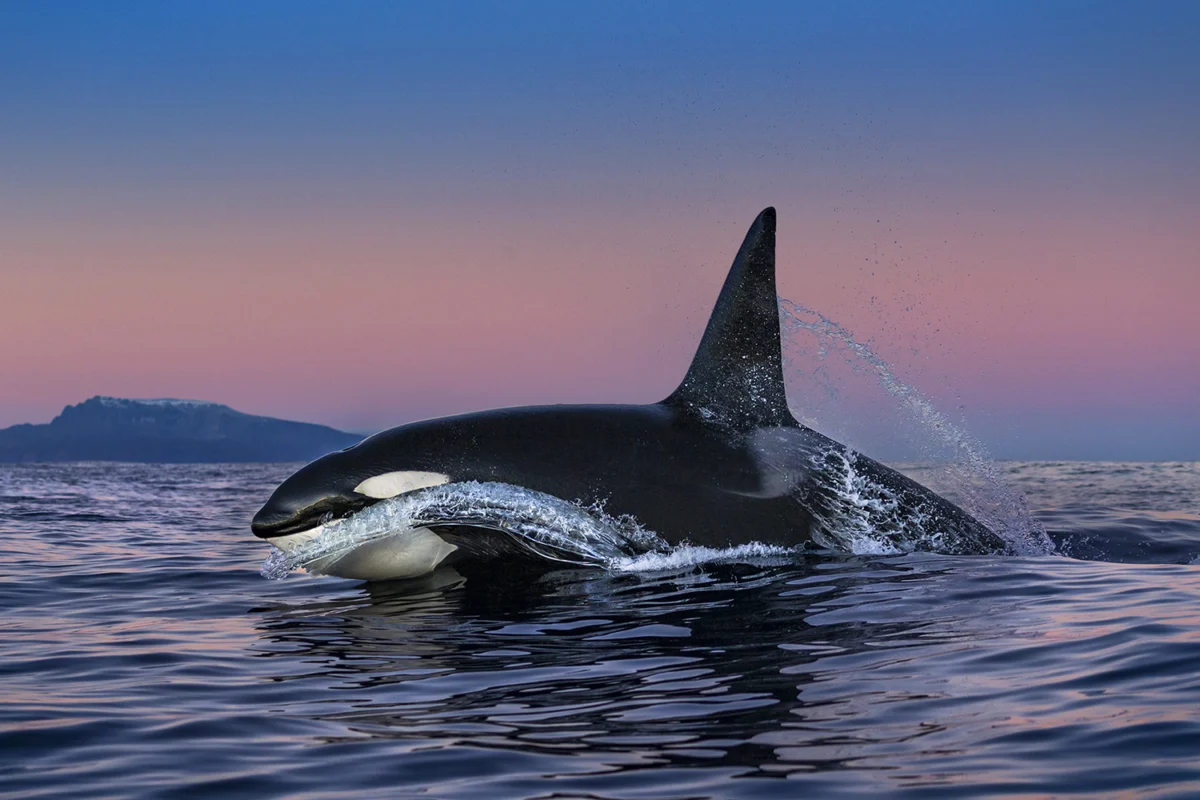
It was at this opportune moment that a particularly large male orca initiated an astonishing display of porpoising, leaping from the water with "furious speed and power." The impact of its powerful movements sent "explosions of water streaming off his body with each leap." This powerful, rhythmic breaching, a rare sight for Norwegian orcas, transformed the scene into an unforgettable spectacle.

Nicklen describes the intensity of the moment: "And yet, without warning, something suddenly triggered them. They were still distant, but it was clear that something was happening – had happened. Something that excited them. They were in a feeding frenzy. We came alive, our senses suddenly alert and active, as if flicked on by a switch."
The sheer scale of the animal was awe-inspiring. This male orca, estimated to weigh 12,000 pounds and measure 25 feet in length, possessed a dorsal fin six feet tall and pectoral fins the size of a car hood. Witnessing such a massive creature move with such agility and force was a testament to its raw power and evolutionary prowess.
The Photographer’s Challenge: Capturing the Uncapturable
The low light conditions presented a significant technical challenge for Nicklen. To freeze the action of the rapidly moving orca, a high shutter speed was essential. However, in such dim light, achieving the required speed often necessitates a wider aperture, which can reduce the depth of field, making it difficult to keep the entire subject in sharp focus.
"The light is almost always low in these kinds of situations," Nicklen explains. "You have to make a tricky calculation, and do it quickly. You want a shutter speed that is fast enough to freeze a snapshot in time, otherwise the action will be blurred."
Furthermore, using professional single-lens reflex (SLR) cameras meant that the photographer was temporarily "blind" during each shot, as the mirror mechanism had to lift and the shutter to operate. This rapid firing, at ten frames per second, meant that for crucial fractions of a second, he had no visual confirmation of whether he was successfully capturing the image.
"With single-lens reflex cameras, it was always hard to tell I was getting the shot or not. I was shooting at ten frames a second, which means that ten times every second I was blind because the mirror has to lift, the shutter has to rise, and the image is exposed. Essentially, I had no clue if I had captured the shot or not."
The Reward: A Perfect Composition of Light, Motion, and Emotion
The success of the photographic endeavor was not solely reliant on Nicklen’s skill but also on the precise coordination with the boat’s captain, Goran. His ability to maintain the optimal speed and distance, matching the orcas’ movements, was crucial.
"Somehow my friend Goran, who was driving the boat that day, had paced us perfectly. Everything came together," Nicklen states.

Upon reviewing the captured images on his camera’s LCD screen, Nicklen experienced a profound sense of satisfaction. The photograph, titled "Dawn Patrol," perfectly encapsulated the essence of the moment. The water droplets, frozen mid-air as they streamed from the orca’s body, the subtle play of light on its skin, the dramatic backdrop of the mountains, and the raw power emanating from the animal – all elements converged to create a masterpiece.
"Sitting in the back of the boat, I held up my camera so I could see the back, with the picture on my LCD screen, and I immediately saw that the whole package was there. It was beautiful. The water splashing off the eye of the orca, running down its body – the light, the mood, the color . . . perfect."
The sharpness of the image, particularly the detail in the orca’s eye, was a significant achievement given the challenging conditions. Nicklen had doubted the possibility of capturing such fine detail at that distance and speed. "At the time, I thought there was no way I would be able to zoom in on the eye of the orca. There was no way it would be sharp. And yet, when I tapped that button, I saw that the eye was sharp. The whole image was sharp. I scrolled down and up, up and down, just waiting for that mistake that told me I had failed somehow. It never came."
The Broader Implications: Conservation and the Wonder of Nature
The "Dawn Patrol" image serves as more than just a stunning piece of wildlife photography; it is a powerful testament to the untamed beauty of the natural world and a poignant reminder of the importance of conservation. Orcas, as apex predators, play a critical role in maintaining the health of marine ecosystems. Their presence in Norwegian waters highlights the ecological significance of these regions and the need for their protection from threats such as habitat degradation, pollution, and overfishing, which can impact their prey base.
The experience of witnessing such a rare and magnificent display underscores the profound connection humans can forge with nature. Nicklen’s reflection on the moment emphasizes this transformative aspect: "These are the gifts of nature that transform the beauty of the natural world into your camera. You realize, in that moment of clarity and epiphany, that you have captured this perfect little bottle of light and time that will live on forever."
The successful capture of this extraordinary event provides valuable data and imagery that can contribute to scientific understanding and public awareness. It inspires awe and a deeper appreciation for these intelligent creatures and their complex social structures. As climate change continues to impact marine environments globally, understanding and documenting the behavior and habitats of species like the orca becomes increasingly vital for informing conservation strategies and ensuring their survival for future generations. The enduring power of the "Dawn Patrol" image lies not only in its technical brilliance but also in its ability to evoke wonder and a sense of shared responsibility for the planet’s natural heritage.