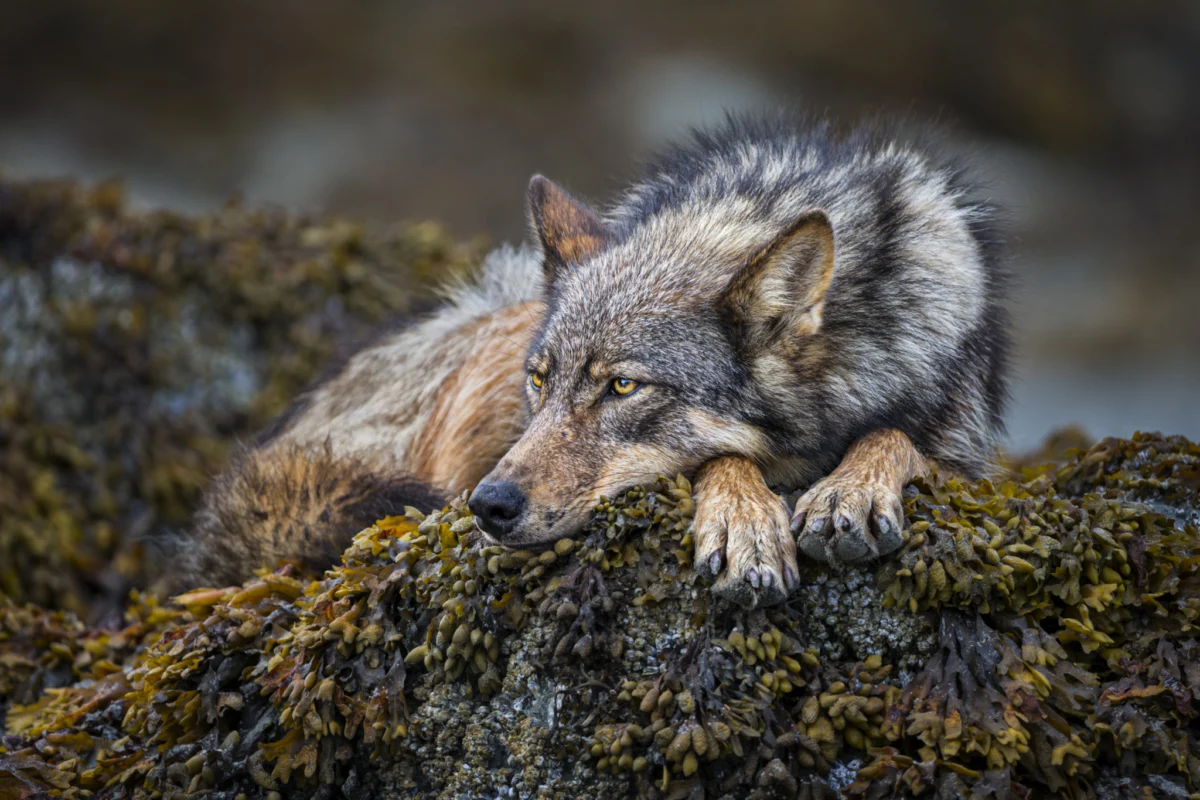
Thirty years ago, I chartered a pilot to drop me off alone in the aptly named Barren Grounds, just 300 miles north of the Arctic Circle. For three months, I hiked over 600 miles on foot and canoed over 2,000 miles through the Canadian wilderness. Mostly, I wanted to test my limits and prove to myself that I could survive on my own. My outward objective, however, was to photograph tundra wolves. After weeks of fruitless searching, I spotted what seemed to be a flat, greyish rock nestled among the lupines. Heart racing, I dropped to the ground and crawled on my belly for the better part of an hour, inching closer until I was just 20 yards away. Through the tangled willows, I finally glimpsed a pair of tawny eyes, perked ears, and the silver face of a lone wolf.
Since that initial solo venture, I have encountered many more wolves and even had the honor of lounging feet away from a perfectly relaxed pack. Each interaction has been an intensive course in patience as I slowly earned their trust. Wolves are shy by nature, highly cautious, and rarely approach humans. Attacks on people are so scarce that only a handful have ever been recorded across North America within the last century. Nevertheless, the archetype of the "big bad wolf" persists in fiction, film, and timeless lore. Humans, after all, love to be scared.
While most of us know that wolves do not impersonate grannies to trick children or huff and puff houses to the ground, we still carry an inherent fear fueled in part by childhood stories and legends. Fairy tales like Little Red Riding Hood seem harmless enough, but as biodiversity continues to plummet across the continent, the fictitious villain suddenly becomes a very real and convenient scapegoat.
When animals like deer and other prey begin to decline in number, wolves are generally the first on the list of suspects. Somewhere between sharpening our pitchforks and pointing fingers, however, we seem to have forgotten that wolves have existed in North America for about 30,000 to 50,000 years—long before the first known arrival of humans.
Overall, the devastation wrought by roads, deforestation, mining, and drilling has inflicted far greater harm on wildlife than wolves ever have. Yet somehow, we still believe the solution to restoring nature lies in trying to control and kill it. Government-sanctioned wolf culls are still regularly implemented as a method of wildlife "management," while corporate entities continue to push for oil dredging and copper mining. The Canadian government is leading a taxpayer-funded extermination of 4,000 wolves in British Columbia alone. Until we learn to hold our own species accountable for the true damage done to our landscapes, the same mistakes will be made again and again.
My hope in sharing the beauty of animals like wolves is to inspire a deeper understanding and appreciation of their story. Villainizing the predators that have maintained balance within their ecosystems for millennia will only plunge us deeper into a cycle of destruction. Every animal, no matter how feared or misunderstood, contributes to the beauty of our world. Shifting our focus to addressing the broader systemic threats that truly endanger our planet is the first step to facing the truth and healing our broken relationship with nature.
The Persistent Shadow of Folklore
The image of the wolf as a monstrous antagonist is deeply ingrained in Western culture. From ancient myths and folklore to modern cinematic portrayals, the wolf has often been cast as a symbol of untamed savagery and inherent danger. This narrative, while potent for storytelling, has had profound and often detrimental consequences for the actual species. The archetypal "big bad wolf" narrative, popularized through tales like "The Three Little Pigs" and "Little Red Riding Hood," has contributed to a widespread, albeit often subconscious, fear and misunderstanding of these apex predators. This cultural legacy predates scientific understanding of wolf behavior and ecology, perpetuating a skewed perception that has historically justified their persecution.
The persistence of these fictional narratives, even in an era of increased scientific literacy, highlights a disconnect between human imagination and ecological reality. While the literal interpretations of these stories are widely recognized as fiction, the underlying emotional resonance—the fear of the wild, the unknown, and the predatory—continues to influence public perception and policy. This ingrained fear makes it challenging to foster a more nuanced and evidence-based understanding of wolves and their vital role in the natural world.
Ecological Significance and Historical Presence
Wolves (Canis lupus) are native to North America, with fossil evidence suggesting their presence on the continent for tens of thousands of years. Their historical range was vast, encompassing nearly every terrestrial ecosystem. As apex predators, wolves play a crucial role in maintaining the health and balance of their environments. They regulate prey populations, preventing overgrazing and promoting plant diversity. By preying on weaker or sick individuals, they also contribute to the genetic fitness of their prey species. This natural regulation is a cornerstone of ecosystem stability, a concept often overlooked when wolves are viewed solely through a lens of threat.
The reintroduction of wolves to areas where they had been extirpated, such as Yellowstone National Park in the mid-1990s, has provided compelling scientific data on their ecological impact. Studies have documented significant positive changes, including the recovery of riparian vegetation due to reduced elk browsing, which in turn has benefited beaver populations and increased biodiversity. These successes underscore the intricate interconnectedness of ecosystems and the cascading benefits of apex predator presence.
The Shifting Landscape of Wolf Management and Human Impact
Despite their ecological importance and long history on the continent, wolves have faced relentless persecution for centuries. Driven by fears stemming from folklore and perceived competition with livestock, widespread eradication efforts were largely successful in eliminating wolves from much of their historical range by the early 20th century. However, in recent decades, a growing understanding of their ecological value has led to some recovery and reintroduction efforts.
This progress is frequently challenged by ongoing human-wildlife conflict, particularly concerning livestock depredation. While documented cases of wolf attacks on humans are exceedingly rare—a point consistently emphasized by wildlife biologists—concerns regarding livestock losses remain a significant factor in public and political discourse. This is often exacerbated by the fact that agricultural expansion and development continue to encroach upon wolf habitats, increasing the potential for conflict.
Data on Wolf Populations and Threats
Current wolf populations across North America are a mosaic of recovery and continued pressure. In the United States, populations have seen some resurgence, particularly in the Northern Rocky Mountains and the Great Lakes region, largely due to dedicated conservation efforts and reintroductions. However, these populations remain vulnerable to hunting, habitat fragmentation, and political shifts in management policies.
In Canada, wolf populations are generally more robust due to the vastness of wilderness areas. Nevertheless, specific populations face localized threats. For instance, the aforementioned extermination program targeting 4,000 wolves in British Columbia, funded by taxpayers, represents a significant conservation concern. This program, often framed as a measure to protect other species or manage disease, raises questions about its efficacy and the broader implications for ecosystem health. The justification for such culls frequently centers on protecting vulnerable species or managing perceived overpopulation, but these arguments often lack comprehensive scientific backing and fail to address the root causes of ecosystem imbalance.
Analysis of Implications: The Cost of Misguided Management
The continued reliance on lethal control methods for wolf management, despite mounting evidence of their ecological benefits, carries significant implications.
- Ecological Imbalance: Removing wolves disrupts natural predator-prey dynamics, potentially leading to overpopulation of herbivores, which can result in habitat degradation. This, in turn, can negatively impact numerous other species that depend on those habitats.
- Economic Inefficiencies: While intended to protect livestock, large-scale culls are costly and often fail to provide long-term solutions. The economic impact of habitat degradation and the loss of ecosystem services can far outweigh the perceived benefits of predator removal.
- Erosion of Public Trust: Controversial management decisions, especially those involving large-scale killing of native wildlife, can erode public trust in government agencies and conservation efforts. Transparency and robust scientific justification are crucial for building and maintaining public support for wildlife management.
- Missed Opportunities for Ecotourism: Healthy wolf populations can be a significant draw for ecotourism, providing economic benefits to local communities through wildlife viewing and related activities. Persecuting these animals negates such potential economic opportunities.
The Broader Context: Systemic Threats to Biodiversity
The debate surrounding wolves often distracts from the more pervasive and systemic threats to biodiversity across the continent. Habitat loss and fragmentation due to industrial development—including roads, mining, oil and gas extraction, and urban sprawl—are the primary drivers of species decline. Climate change further exacerbates these pressures, altering ecosystems and pushing species beyond their adaptive capacities.
Focusing on wolves as a scapegoat for broader ecological problems is a misdirection of resources and attention. It allows for the continuation of destructive industrial practices while targeting a species that, in fact, contributes to ecological resilience. The narrative needs to shift from "controlling" or "eliminating" perceived problematic species to addressing the fundamental drivers of biodiversity loss. This requires a comprehensive approach that prioritizes habitat conservation, sustainable land-use practices, and a fundamental reevaluation of humanity’s relationship with the natural world.
A Call for a Paradigm Shift
The enduring myth of the "big bad wolf" has served as a convenient narrative to justify fear and persecution. However, as we confront an unprecedented biodiversity crisis, it is imperative to move beyond these outdated perceptions. The scientific evidence clearly demonstrates the ecological value of wolves and the detrimental consequences of their absence.
As author Robin Wall Kimmerer aptly stated, "As we learn to listen to the land, we discover that we are not separate from it; we are part of it." This profound realization demands a paradigm shift in how we approach wildlife management and our stewardship of the planet. Instead of villainizing apex predators, we must embrace their role in maintaining healthy ecosystems. This means holding ourselves accountable for the true damage inflicted by industrial activities and prioritizing conservation strategies that work in harmony with nature, rather than against it. The future of countless species, including our own, depends on our ability to foster a deeper understanding and appreciation for the intricate web of life that sustains us all.