
The convergence of high-end mobile technology and classic street photography aesthetics has revolutionized how urban life is documented in the 21st century. As smartphone hardware continues to bridge the gap between consumer devices and professional-grade equipment, a growing number of photographers are turning to the iPhone as their primary tool for capturing the raw, candid essence of the city. While color photography often dominates social media feeds, the timeless allure of black and white imagery remains a cornerstone of the genre, favored for its ability to strip away distractions and focus on the fundamental elements of light, shadow, and form.
The shift toward mobile street photography is supported by significant market data. According to recent industry reports, over 90% of all photographs taken globally are now captured on smartphones. On platforms such as Flickr, the iPhone consistently ranks as the most popular camera brand, surpassing traditional giants like Canon and Nikon. This democratization of photography has led to a resurgence of the "street" genre, where the best camera is defined not by its sensor size, but by its presence and accessibility.
The Evolution of the Digital Darkroom
The practice of street photography has historically been defined by the "decisive moment," a term coined by Henri Cartier-Bresson. In the analog era, this required mastery of manual focus and a deep understanding of film stock. Today, the iPhone’s computational photography capabilities have shifted the focus from technical settings to compositional intent. One of the most effective strategies for modern practitioners is the adoption of a monochromatic workflow from the moment of capture.
While many amateur photographers choose to convert color images to black and white during post-processing, experts suggest that shooting directly in a monochromatic mode—such as the iPhone’s "Noir" filter—is superior for developing a "photographic eye." By viewing the world through a grayscale lens in real-time, the photographer can more easily identify high-contrast scenes, intricate patterns, and the play of light that might be obscured by a busy color palette. Because the iPhone’s filters are non-destructive, the original color data is preserved, allowing for total flexibility in the editing suite while providing the immediate benefit of a focused, monochromatic preview.
Minimalism and the Utilization of Negative Space
In the dense, often chaotic environment of a modern metropolis, visual clutter is the primary enemy of a successful composition. The most impactful street photography often adheres to the principles of minimalism. By isolating a single subject within a vast expanse of "negative space," the photographer creates a clear narrative path for the viewer’s eye.
Data from visual psychology studies indicates that the human brain processes simplified images more quickly and retains them longer. In an urban context, finding this simplicity requires a strategic approach to location scouting. Public squares, expansive parks, and modern cultural sites are ideal for minimalist compositions. Digital tools like Google Maps and Street View have become essential for photographers to identify these "open" spaces before they even step outside. The objective is to find a clean background and wait for a human element to enter the frame, providing a sense of scale and a focal point for the surrounding emptiness.
Urban Geometry and Leading Lines
The architectural skeleton of a city provides an endless supply of leading lines—powerful compositional tools that direct the viewer’s attention toward a specific subject. Roads, bridges, tunnels, and even road markings act as visual conduits. When these elements are captured in black and white, their structural importance is magnified.
A common technique among professional mobile photographers involves positioning the camera so that lines originate from the corners of the frame. This "corner-to-subject" approach creates a sense of three-dimensional depth on a two-dimensional screen. Beyond straight lines, curved elements such as spiral staircases offer a more fluid, organic form of geometry. Shooting from high vantage points looking downward can transform a mundane architectural feature into a hypnotic, abstract pattern.
Patterns and Symmetry in Modern Architecture
Modern urban design is characterized by repetition. Facades of glass and steel, rows of identical windows, and colonnades of pillars offer a rhythmic quality to street photography. These patterns hold the viewer’s attention by encouraging them to scan the frame for details and deviations.
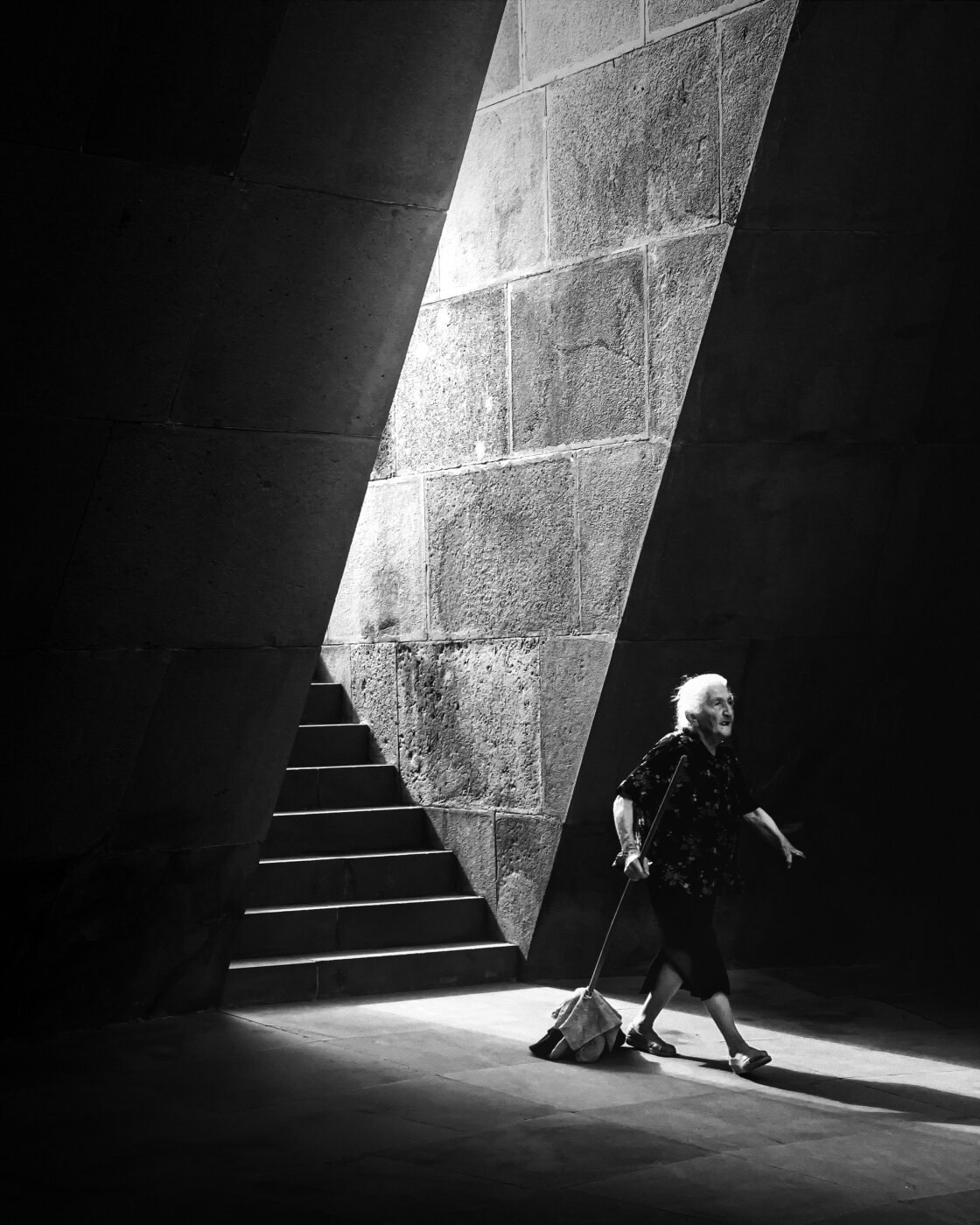
Symmetry plays a crucial role in this aesthetic. Centering a symmetrical building within the frame creates a sense of balance and permanence. However, the introduction of a human subject—a "break" in the pattern—often provides the necessary tension to make a photo compelling. The contrast between the rigid, unchanging architecture and the fleeting presence of a pedestrian creates a narrative about the relationship between humanity and the built environment.
The Technicality of Framing and Burst Mode
Framing is a sophisticated compositional technique where elements within the scene—such as archways, doorways, or windows—are used to enclose the primary subject. This "frame within a frame" adds layers to the image and reinforces the focal point.
To successfully execute these shots, photographers often rely on "Burst Mode." In the unpredictable environment of the street, the difference between a mediocre shot and a masterpiece can be a fraction of a second. By capturing a rapid sequence of images as a subject moves through a frame, the photographer ensures they can select the frame with the most graceful posture or the most balanced positioning. On the iPhone, this is achieved by dragging the shutter button to the left or holding the volume-up button, a feature that has become indispensable for high-stakes street work.
Masterclass in Light: Silhouettes and Shadows
Black and white photography is, at its core, the study of light. Silhouettes and shadows are two of the most dramatic expressions of this study. A silhouette is created by shooting toward a light source, rendering the subject as a dark, featureless shape against a bright background. This technique strips away the subject’s identity, turning them into a mysterious, universal figure.
The "Golden Hour"—the period shortly after sunrise or before sunset—is the optimal time for this type of work. The low angle of the sun produces long, distorted shadows that can become subjects in their own right. Technical mastery of exposure is required here; photographers must often manually reduce the iPhone’s exposure value (EV) to ensure that the shadows are deep and the highlights are not "blown out" or overexposed. On newer iPhone models, the dedicated exposure slider allows for precise control, enabling the user to darken the scene until the desired level of drama is achieved.
Post-Processing and the Digital Workflow
The final stage of creating incredible black and white street photos occurs in the editing suite. While the iPhone’s internal hardware handles much of the heavy lifting through Smart HDR and Deep Fusion technology, manual adjustments are necessary to refine the artistic vision.
Applications such as Adobe Lightroom Mobile and the native iOS Photos app provide professional-grade tools for adjusting contrast, highlights, and shadows. A key trend in modern black and white editing is the "crushing" of blacks—increasing contrast to the point where shadow detail is lost, creating a bold, graphic look. Additionally, the use of "healing" or "retouch" tools has become a standard practice for removing minor distractions like trash on a sidewalk or a stray sign that disrupts a minimalist composition.
The Broader Impact of Mobile Street Photography
The rise of the iPhone as a serious photographic tool has broader implications for the art world and journalism. The unobtrusive nature of a smartphone allows photographers to blend into the environment more effectively than they could with a bulky DSLR and a long lens. This leads to more authentic, candid captures of the human condition.
Furthermore, the immediate ability to edit and distribute images via high-speed cellular networks has turned every iPhone user into a potential documentarian. In a world where visual literacy is increasingly important, the mastery of these eight tips allows individuals to move beyond simple "snapshots" and contribute to the rich tradition of street photography.
As technology continues to evolve, with rumors of larger sensors and improved optical zoom in future iPhone iterations, the boundary between mobile and professional photography will continue to blur. However, the fundamental principles of black and white composition—light, shadow, geometry, and timing—remain constant. For photographers like Maksim Kyshtymov and others who have embraced the mobile revolution, the iPhone represents a liberation from gear-heavy workflows, proving that incredible art is the result of a creative vision rather than the complexity of the tool.