A landmark exhibition at the Martin Parr Foundation in Bristol, England, is set to unravel over 80 years of British and Irish documentary photography through an unconventional yet profoundly insightful filter: the Gothic lens. Titled Dark Tales: Britain and Ireland Through a Gothic Lens, this exhibition, running from September 17 through December 20, offers a compelling re-examination of how the camera has captured the darker, more unsettling dimensions of life across these islands, bridging the artistic realms of social commentary and psychological unease.
The exhibition’s central premise hinges on the enduring relationship between documentary photography and the Gothic tradition, a cultural and artistic movement historically associated with darkness, mystery, psychological tension, and the unsettling transformation of ordinary places and experiences. From the crumbling castles and haunted landscapes of 18th-century literature to the grim realities documented by 20th-century photographers, the Gothic has consistently served as a powerful idiom for exploring societal anxieties, moral quandaries, and the inherent darkness that can pervade human existence. By applying this lens, curator Isaac Blease invites viewers to perceive familiar historical narratives and social documentations with a fresh, often disquieting, perspective.
The Gothic Aesthetic: From Literature to Lenses
To fully appreciate the curatorial vision behind Dark Tales, it is essential to understand the core tenets of the Gothic tradition. Originating in 18th-century literature with works like Horace Walpole’s The Castle of Otranto, the Gothic rapidly evolved beyond mere architectural descriptions to encompass a pervasive atmosphere of dread, decay, and psychological torment. Key elements include dilapidated settings, isolated characters, supernatural undertones, emotional extremism, and a sense of the uncanny – where the familiar becomes strangely unfamiliar and threatening. Over centuries, the Gothic has proved remarkably adaptable, morphing from overt horror to subtle psychological unease, consistently reflecting the prevailing fears and societal tensions of its era.
In the context of documentary photography, these Gothic elements translate into visual narratives that transcend mere factual reporting. A photograph depicting industrial decline, for instance, might evoke a sense of decay and lost grandeur akin to a ruined castle, while images of confined domestic life can suggest psychological entrapment or hidden tensions. Nighttime scenes, with their inherent shadows and mysteries, naturally align with the Gothic’s embrace of darkness and the unknown. The "unsettling" quality arises not necessarily from overt horror, but from the subtle suggestion of vulnerability, alienation, or an underlying malaise within the fabric of society.
Isaac Blease, the exhibition’s curator, articulates this connection succinctly: "From its inception, photography has been a medium used to record the troubled, political, moral and social issues that have unsettled the modern world: a certain darkness creeps throughout its histories." He further elaborates that just as Gothic authors conveyed anxieties through fiction, photographers have mirrored the darkness of their times through real-world images, creating "artworks that invoke within us a similar sense of terror and wonder at the tangible and psychological realities depicted." This curatorial stance positions documentary photography not merely as a mirror reflecting reality, but as an interpreter, capable of imbuing reality with a profound, often unsettling, emotional resonance.
A Chronology of Shadows: Britain and Ireland Through the Decades
The exhibition draws primarily from the extensive archives of the Martin Parr Foundation, featuring over 5,000 prints, allowing Blease to meticulously select a mix of iconic and lesser-known works that span more than eight decades. This chronological sweep reveals how the Gothic thread has consistently woven itself through the social fabric of Britain and Ireland, adapting its form to reflect shifting historical anxieties.
Post-War Austerity and Early Disillusionment (1940s-1960s):
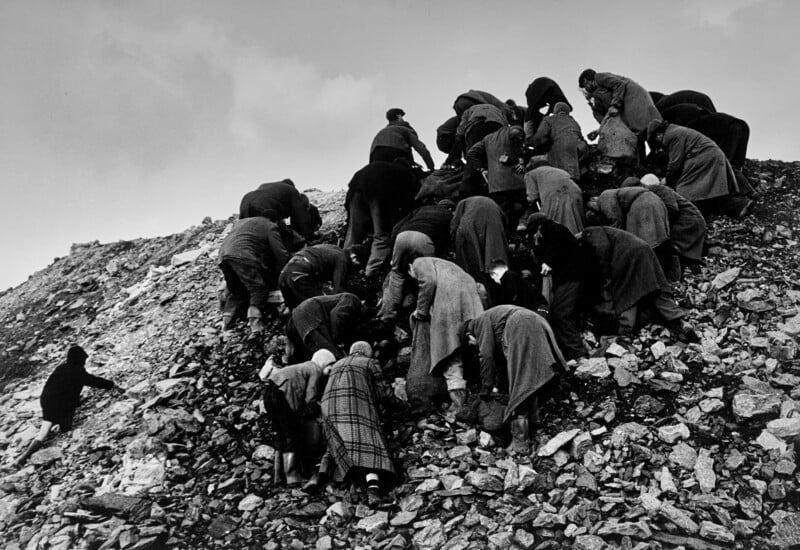
The immediate post-World War II era in Britain and Ireland was characterized by reconstruction, rationing, and a pervasive sense of austerity. While hope for a new future existed, the scars of war and the challenges of rebuilding often cast a long shadow. Photographers like Bill Brandt, whose work is featured in the exhibition, were instrumental in shaping the visual narrative of this period. Brandt, known for his stark, often surrealist-influenced images of British society, landscapes, and interiors, masterfully captured a sense of melancholic introspection and a quiet unease. His photographs of coal miners, domestic scenes, and desolate urban landscapes often possess a haunting quality, stripping away superficial glamour to reveal a raw, sometimes bleak, reality. This period also saw the rise of social realism in documentary photography, focusing on the lives of ordinary working people, their struggles, and the changing industrial landscape. Colin Jones’s "Sunderland, North East of England, 1962" depicting coal scavengers on a mound, is a poignant example. It speaks to the hardship and resilience in a region heavily impacted by industrial shifts, presenting a stark, almost primal scene of human endeavor against a backdrop of economic struggle. The image evokes a sense of timeless toil, a gothic echo of human struggle against harsh environmental and economic conditions.
The Age of Unrest and Industrial Decline (1970s-1980s):
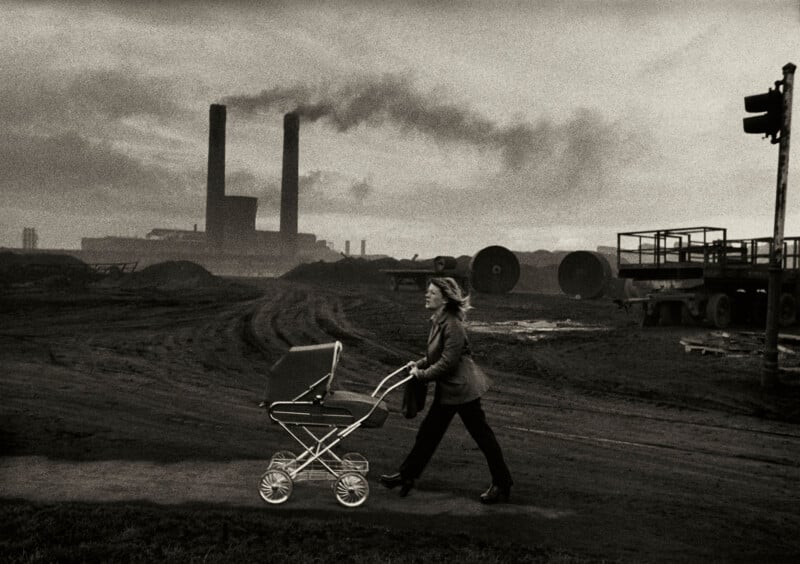
The 1970s and 1980s were tumultuous decades for Britain and Ireland, marked by significant industrial decline, social unrest, and political upheaval. The collapse of traditional industries like coal mining and shipbuilding led to widespread unemployment and community devastation, particularly in the North of England and other industrial heartlands. Don McCullin, an acclaimed war photographer, also turned his unflinching gaze to the plight of his own country. His powerful image "Woman with pram, Consett, 1974," captures a solitary figure pushing a pram across a muddy, desolate industrial landscape, with factory chimneys belching smoke in the background. This photograph is a potent symbol of hardship, environmental decay, and the seemingly endless cycle of struggle. It embodies a gothic landscape of human endurance in the face of a brutal, unforgiving environment, where the everyday act of pushing a pram becomes an act of quiet desperation.
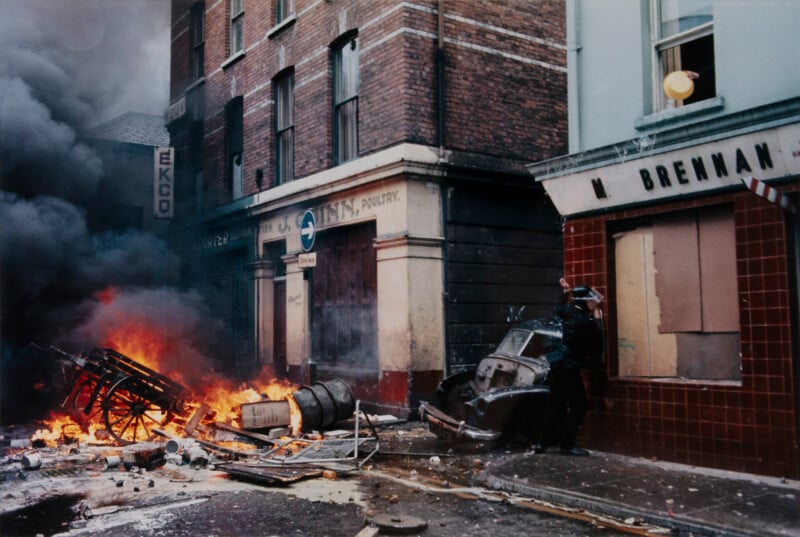
Concurrently, Northern Ireland was gripped by "The Troubles," a period of intense sectarian conflict. Images from this era, such as Akihiko Okamura’s "Derry/Londonderry, Northern Ireland, at around 4 PM on August 12, 1969," capture the raw chaos and fear of street battles, burning debris, and shattered urban spaces. These images are inherently gothic in their depiction of societal breakdown, collective trauma, and the haunting presence of violence that transforms familiar streets into zones of terror.
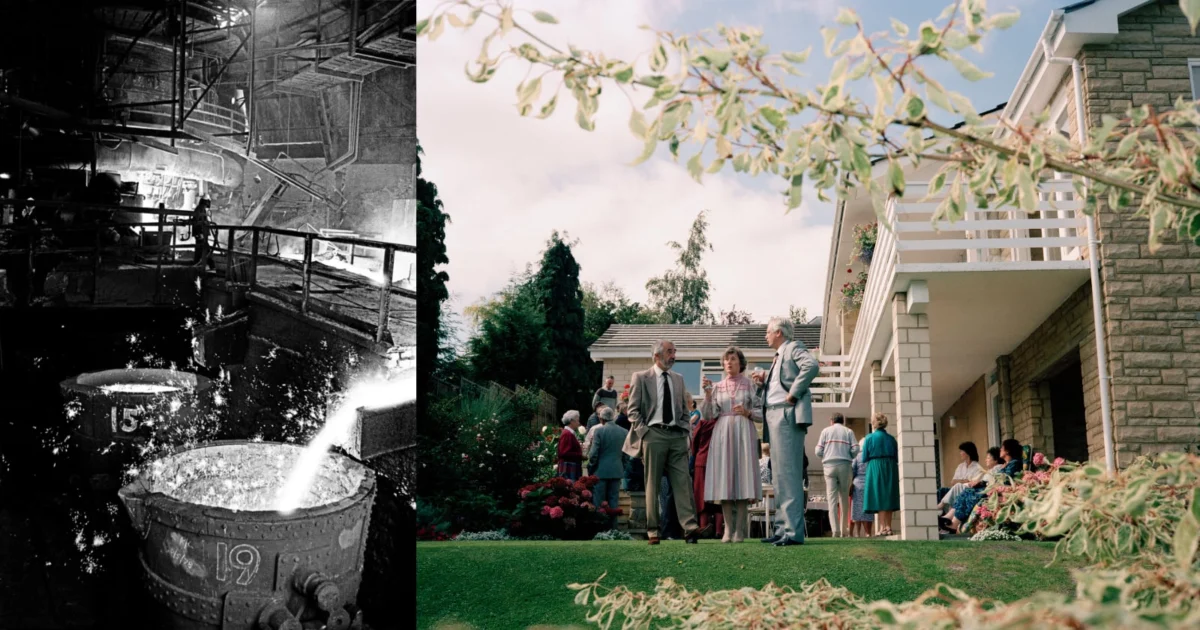
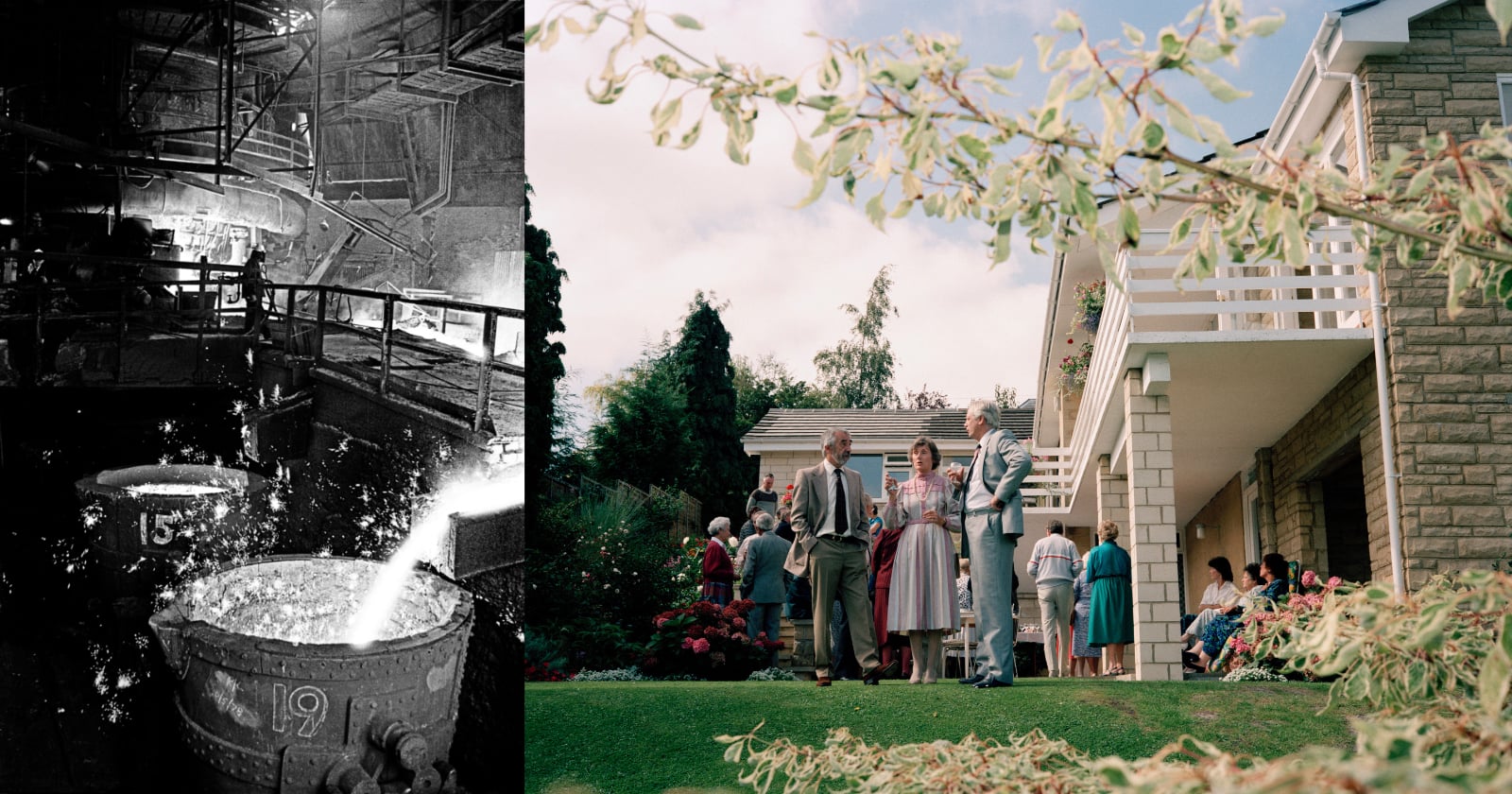
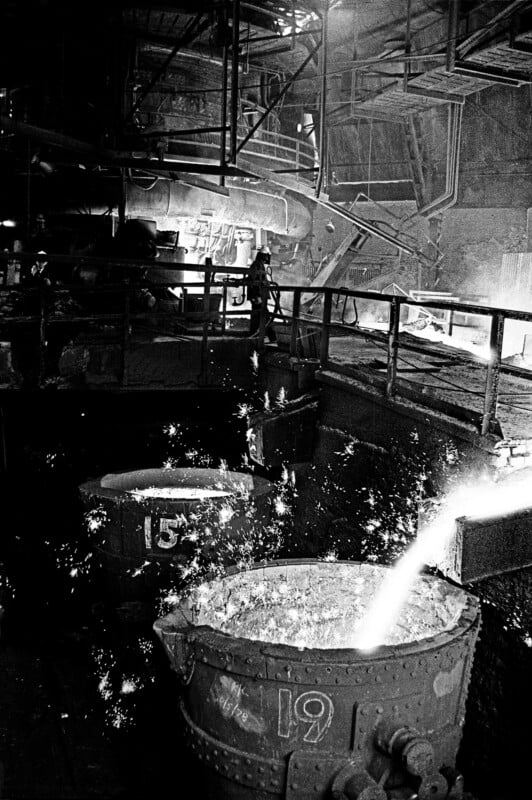
During this period, photographers like Janine Wiedel documented the grueling realities of heavy industry. Her images from "Shelton Bar Iron Works, Stoke-on-Trent, 1978," such as "Molten Iron" and "Shelter from the Heat," reveal the hellish conditions within steelworks. The glowing molten metal, the protective gear of workers resembling shadowy figures, and the oppressive, dangerous environment create a visceral sense of the sublime and terrifying power of industry, mirroring the industrial Gothic themes found in 19th-century literature. These photographs capture a dying industry, its colossal machinery and human figures dwarfed by fire and steel, creating an atmosphere of both awe and impending obsolescence.
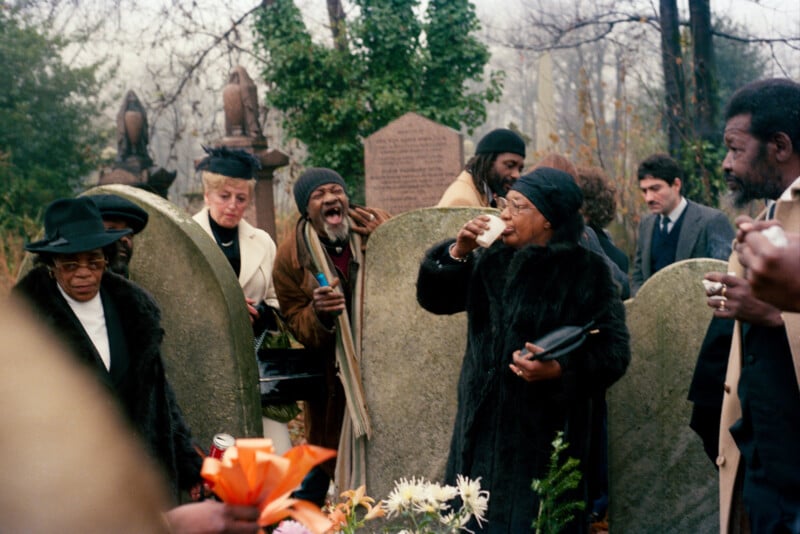
Meanwhile, Charlie Phillips’s "Kensal Rise, 1988," likely a funeral scene, offers a different facet of the Gothic. Phillips, renowned for documenting the Black British experience in Notting Hill, here captures a moment of collective grief and solemnity. The figures in dark attire gathered amidst gravestones evoke the traditional imagery of mourning, loss, and the ever-present specter of mortality, a fundamental theme within the Gothic tradition.
Late 20th and Early 21st Century Anxieties:
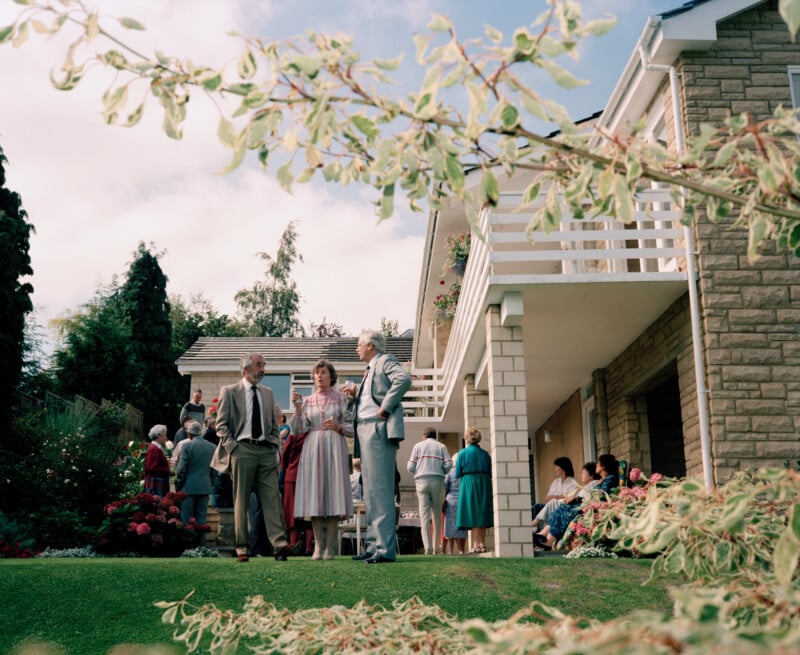
As Britain transitioned into a post-industrial, consumer-driven society, the Gothic lens adapted to new forms of anxiety. Martin Parr’s own work, though often characterized by vibrant color and humorous observation, frequently delves into the unsettling absurdities of modern life, revealing the grotesque or alienating aspects of consumer culture and leisure. His "Conservative Party fundraiser, England, 1988," while seemingly depicting a jovial gathering, can be interpreted through a gothic lens as a performance of power and privilege, perhaps with an underlying sense of detachment or artificiality that can be profoundly unsettling.
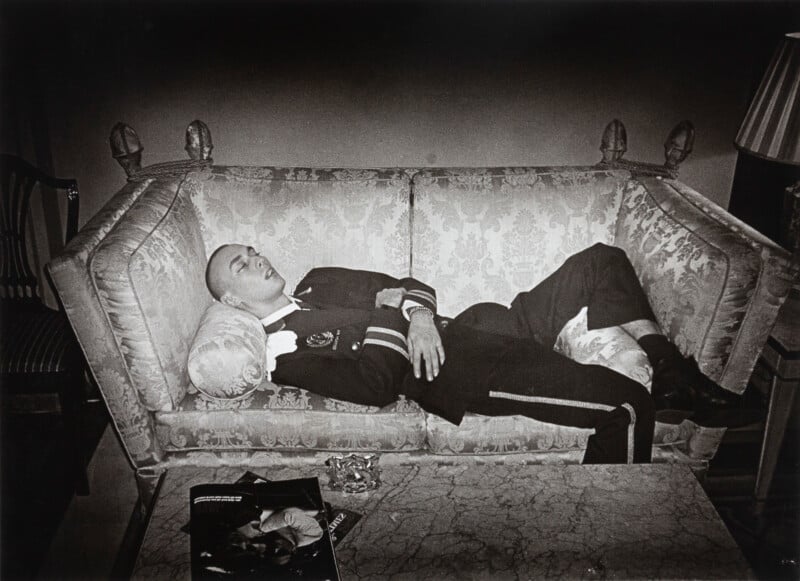
The exhibition extends to the turn of the millennium and beyond, capturing contemporary forms of unease. Chris Shaw’s "Jordi the Lounge Lizzard – The Howard Hotel, London 1999/2000," portrays a figure asleep on a patterned sofa in a dimly lit hotel lobby. This image evokes a sense of urban isolation, transient existence, and the quiet despair that can lurk beneath the surface of modern city life – a psychological gothic, where the setting is not a haunted castle but a soulless public space.
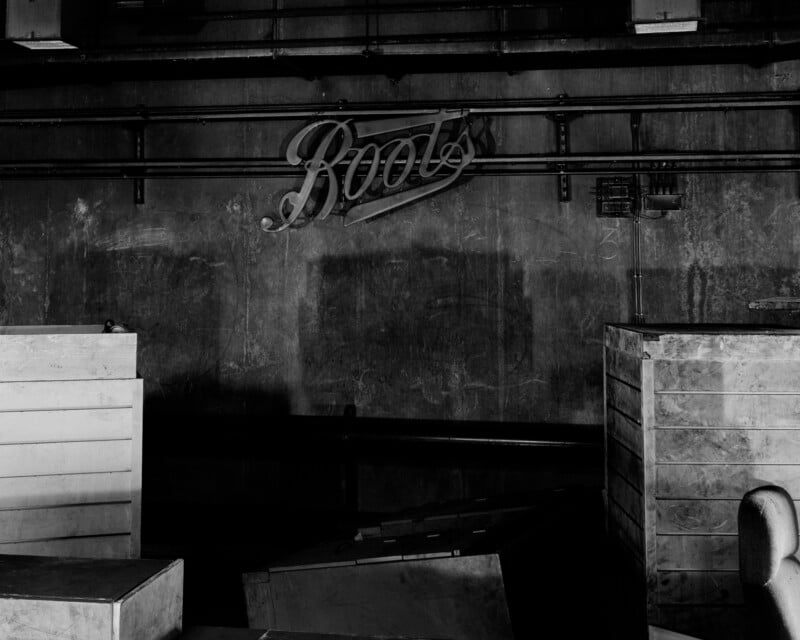
Finally, Sarah Pickering’s "Boots, 2008," from her series Incident, presents an empty, dimly lit room with industrial piping and a vintage "Boots" sign. Pickering’s work often explores themes of artificiality, simulation, and the uncanny in familiar environments. This photograph, devoid of human presence, creates a sense of abandonment and mystery, hinting at untold stories and past events, transforming an ordinary space into something pregnant with unspoken narratives – a powerful example of the contemporary Gothic.
The Martin Parr Foundation: A Repository of Reality
The Martin Parr Foundation, established by the celebrated British photographer Martin Parr, serves as a vital hub for documentary photography. Its mission to preserve, showcase, and promote the legacy of British and Irish documentary photography makes it an ideal venue for an exhibition of this nature. Housing over 5,000 prints, the Foundation’s collection is an unparalleled resource, offering a panoramic view of social history through the photographic medium. The decision to curate Dark Tales primarily from this collection underscores the richness and depth of the archive, demonstrating its capacity to support diverse interpretations and thematic explorations. Martin Parr himself, known for his critical and often ironic gaze on British society, implicitly understands the "darker" aspects of human behavior and social structures, making his foundation a natural home for such an exhibition.
Curatorial Insights and the Power of Selection
Isaac Blease’s curatorial approach is a testament to the versatility of documentary photography and the enduring relevance of the Gothic tradition. By meticulously sifting through thousands of images, Blease has crafted a narrative that transcends chronological presentation, instead focusing on thematic resonance. His selection process likely involved identifying photographs that, regardless of their original intent, possess an inherent atmospheric quality, psychological depth, or a depiction of decay, isolation, or the uncanny. This allows for unexpected juxtapositions and dialogues between works from different eras and by different photographers, revealing a shared sensibility.
The exhibition’s focus on "declining industry, confined domestic life, and nighttime scenes" as key Gothic motifs is particularly insightful. Declining industry speaks to ruination and the haunting of former glories; confined domestic life evokes psychological tension and claustrophobia; and nighttime scenes naturally plunge viewers into mystery and fear of the unknown. These categories provide a structural framework for understanding how disparate images can collectively articulate a "dark tale."
Documentary Photography in a Digital Age: Confronting Skepticism and AI
Beyond its historical and artistic exploration, Dark Tales carries a profound contemporary relevance. Curator Blease poignantly observes that "documentary photography itself is in a dark moment, with its purpose and role in question, public distrust of ‘photographers’, and the existential threat posed by Artificial Intelligence." This statement addresses a critical crisis facing visual media today. The proliferation of deepfakes, AI-generated images, and the ease with which digital content can be manipulated has eroded public trust in photographic authenticity. In an era where "seeing is believing" is increasingly challenged, the very foundation of documentary photography – its claim to represent reality – is under scrutiny.
In this context, Dark Tales emerges as a timely and vital intervention. By showcasing decades of real-world documentary photography through a lens that acknowledges inherent ambiguity and psychological depth, the exhibition implicitly argues for a more nuanced understanding of truth in images. It suggests that while photographs record reality, they also interpret it, evoking emotions and narratives that go beyond mere surface-level facts. The Gothic, with its embrace of mystery and the unsettling, provides a framework for exploring these deeper layers of meaning without succumbing to outright fabrication.
Blease highlights that this "moment of turmoil presents intriguing conditions to explore the Gothic imagination as a relevant lens through which to re-examine the medium, while also reveling in the ambiguity of images and the multitude of meanings they evoke." This perspective encourages viewers not to dismiss documentary photography for its perceived lack of absolute truth, but to engage with its complexities, its capacity to reflect societal anxieties, and its power to provoke thought and emotion. It is a call to appreciate the interpretative dimension of photography, reminding us that even the most stark documentary image can carry a symbolic weight and a profound sense of the human condition.
The exhibition, therefore, serves as a powerful statement on the enduring value of human-made, real-world photography. It subtly asserts that while AI can generate perfect fictions, only human photographers, grappling with the real world, can capture the messy, ambiguous, and often dark truths that truly define our existence.
Conclusion
Dark Tales: Britain and Ireland Through a Gothic Lens at the Martin Parr Foundation is more than just a photography exhibition; it is a profound cultural commentary. By marrying the rich tradition of documentary photography with the evocative power of the Gothic aesthetic, Isaac Blease has created a unique space for reflection on history, society, and the very nature of visual truth. From the stark industrial landscapes of the mid-20th century to the subtle urban alienations of the present day, the exhibition reveals a continuous thread of unease and psychological depth in the British and Irish experience. In an age grappling with questions of authenticity and the impact of artificial intelligence, Dark Tales offers a timely reminder of documentary photography’s irreplaceable role in capturing, interpreting, and confronting the often-unsettling realities of our world. It promises to be an immersive and thought-provoking experience, inviting visitors to delve into the shadows and uncover the enduring power of the photographic image.