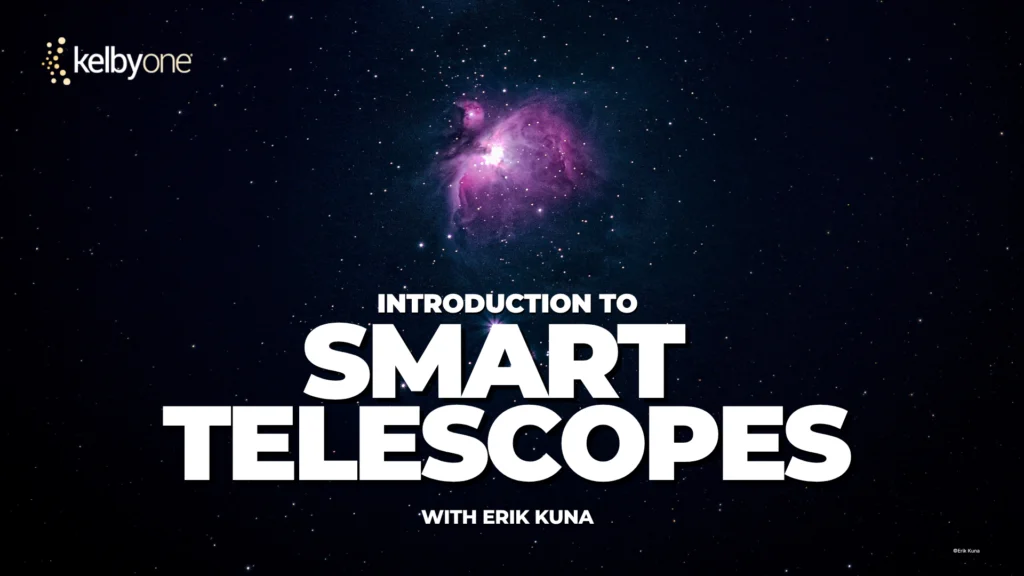
The pursuit of capturing the ethereal beauty of distant galaxies, swirling nebulae, and shimmering star clusters has historically been an endeavor reserved for a dedicated few. It demanded not only a substantial financial outlay for specialized equipment but also a significant investment of time and expertise to master the intricate interplay of optics, mechanics, and digital processing. This landscape, however, is undergoing a profound transformation with the advent of smart telescopes, compact, all-in-one devices designed to democratize access to the wonders of the deep sky. This shift is now being formally addressed and explained through a comprehensive new class offered by KelbyOne, taught by renowned photography educator Erik Kuna, which introduces enthusiasts to these innovative instruments and their capabilities.
The Genesis of a Hobby: Traditional Astrophotography’s High Barriers
For decades, aspiring astrophotographers faced a formidable learning curve and prohibitive costs. The traditional setup typically involved a high-quality astronomical telescope, often mounted on a precisely engineered equatorial mount capable of tracking celestial objects with sub-arcsecond accuracy. This mount alone could represent a significant investment, sometimes exceeding the cost of the telescope itself, and required meticulous polar alignment – a complex procedure to align the mount’s rotational axis with the Earth’s celestial pole.
Beyond the core optical and mechanical components, a dedicated astrophotography camera, often a cooled CCD or CMOS sensor to minimize thermal noise during long exposures, was essential. Autoguiding systems, comprising a smaller guide scope and camera, were then necessary to provide real-time corrections to the mount’s tracking, counteracting minor mechanical imperfections and atmospheric distortions. Filters, ranging from light pollution suppression to narrowband filters for isolating specific emission lines of nebulae, further added to the complexity and expense. The entire system required power management, extensive cabling, and often a dedicated laptop running specialized software for telescope control, plate solving (automatically identifying the telescope’s exact pointing direction), image acquisition, and post-processing techniques like stacking hundreds or thousands of individual exposures, calibration frames (darks, flats, biases), and advanced image manipulation to bring out faint details. The sheer volume of equipment, the technical knowledge required for setup and operation, and the lengthy post-processing workflows effectively created a high barrier to entry, limiting deep-sky astrophotography to a relatively small, highly dedicated community.
Smart Telescopes: A Paradigm Shift in Accessibility
The mid-2010s marked the nascent stages of a revolution with the introduction of early smart telescope prototypes, culminating in commercially available models like the Vaonis Stellina and Unistellar eVscope in the late 2010s. These devices represented a radical departure from traditional systems by integrating multiple functionalities into a single, user-friendly unit. Key innovations included:
- Integrated Optics and Imaging: Combining the telescope, camera, and often an internal computer into one compact housing.
- Automated Alignment and Tracking: Utilizing internal GPS, inclinometers, and sophisticated "plate solving" algorithms (which take a quick snapshot of the sky, identify stars, and compare them to an internal star map to determine exact orientation) to automatically align the telescope and track celestial objects without manual intervention or complex polar alignment.
- Live Stacking (Enhanced Vision): A core feature where the telescope continuously captures short exposures and automatically stacks them in real-time. This process significantly reduces image noise and enhances the visibility of faint deep-sky objects, gradually revealing more detail and color on a connected smartphone or tablet screen over minutes. This "enhanced vision" capability bridges the gap between traditional visual observation (often limited by the human eye’s sensitivity to dim objects) and complex long-exposure astrophotography.
- Wireless Control: Complete operation via a smartphone or tablet app, simplifying object selection, focus adjustment, and image capture. This eliminates the need for external laptops and cumbersome cables.
- Portability and Simplicity: Designed for quick setup and breakdown, making spontaneous stargazing sessions viable, even in moderately light-polluted backyards.
While the original article mentions some models coming in under $1,000, it’s important to note that the market has expanded considerably, with many popular and capable smart telescopes ranging from approximately $2,000 to $5,000, offering varying levels of aperture, field of view, and sensor performance. This still represents a significant saving in complexity and often cost compared to building a comparable traditional setup from scratch, which could easily run into five figures. The primary advantage, however, lies in the drastically reduced learning curve and operational simplicity.
Erik Kuna’s KelbyOne Course: Bridging the Knowledge Gap
Recognizing the burgeoning interest and the need for clear, expert guidance in this rapidly evolving field, KelbyOne, a leading online education platform for photographers and creative professionals, commissioned Erik Kuna’s new class, "Introduction to Smart Telescopes." This course aims to serve as a definitive guide for newcomers, demystifying the technology and empowering individuals to embark on their deep-sky photographic journey.
A spokesperson for KelbyOne highlighted the platform’s commitment to making advanced photographic techniques accessible to a wider audience. "The rise of smart telescopes represents a pivotal moment for astronomy enthusiasts and photographers alike," the spokesperson stated. "Our mission at KelbyOne is to provide practical, high-quality instruction that empowers our members to explore new creative avenues. Erik Kuna, with his extensive background in photography education and technology, is uniquely positioned to guide our community through this exciting new frontier."
Kuna, a respected figure in photographic education known for his clear explanations and practical approach, emphasized the transformative potential of these devices. "Many people have gazed at the night sky and dreamt of capturing the stunning images they see from professional observatories," Kuna explained. "Smart telescopes make that dream a tangible reality for an unprecedented number of individuals. My class is designed to cut through the jargon and show people exactly how to get started, what to expect, and how to make the most of these incredible tools."
Understanding the Technology: How Smart Telescopes Work
Kuna’s class delves into the core mechanics that enable smart telescopes to perform their automated functions. At their heart, these devices integrate a small, often high-sensitivity CMOS sensor camera with an optical tube, typically a refractor or a catadioptric design, selected for its portability and relatively wide field of view. The internal computer processes the incoming light, performing several critical tasks:
- Go-To Functionality: Users select a desired celestial object from a catalog within the accompanying smartphone app. The telescope then uses its internal motors to slew (move) to the correct coordinates.
- Plate Solving: Once roughly pointed, the telescope captures a brief exposure, analyzes the star patterns in the image, and cross-references them with an internal star map. This allows for precise identification of its exact orientation and automatically corrects any pointing errors.
- Automated Tracking: After identifying the target, the mount continuously adjusts to compensate for the Earth’s rotation, keeping the object centered in the field of view.
- Automated Focusing: Many smart telescopes include motorized focusers that can automatically achieve sharp focus, eliminating a common frustration for beginners in traditional astrophotography.
- Live Stacking Algorithms: As short exposures (typically 2-15 seconds) are continuously captured, proprietary algorithms instantly align and combine them. This process, known as live stacking or "enhanced vision," accumulates light, reduces random noise, and progressively reveals fainter details and colors that would be invisible in a single short exposure or even through the eyepiece of a similar-sized traditional telescope. The resulting image gradually improves in real-time on the connected device.
Navigating Expectations: Strengths and Limitations
Crucially, Kuna’s curriculum also provides a balanced perspective, outlining not only what smart telescopes excel at but also their inherent limitations. They are optimized for deep-sky objects – galaxies, nebulae, and star clusters – which are extended, relatively dim targets. The live stacking capabilities make these objects visible and often quite stunning, even from moderately light-polluted areas.
However, smart telescopes are generally not designed for:
- High-Resolution Planetary Imaging: Planets and the Moon, being very bright and requiring high magnification and very short exposure times to capture fine surface details, are better suited to larger aperture telescopes, high frame rate cameras, and specialized planetary imaging techniques. While smart telescopes can show basic views of planets, they typically won’t achieve the intricate detail possible with dedicated planetary setups.
- Professional Scientific Research: Their apertures are generally smaller, and their sensors, while good for visual enhancement, may not meet the stringent scientific requirements for calibration, specific wavelength analysis, or extreme sensitivity needed for professional astronomical research.
- Wide-Field Landscape Astrophotography: Capturing the Milky Way arching over a landscape, aurorae, or meteor showers requires wide-angle lenses on DSLR/mirrorless cameras, not telescopes. Smart telescopes are designed for zoomed-in views of specific celestial objects.
- Traditional Visual Observing: While some models offer an eyepiece, the primary experience is digital, viewed on a screen. Purists who enjoy looking through an eyepiece directly may find this less satisfying.
Understanding these distinctions is vital for potential users to manage their expectations and choose the right equipment for their specific astronomical interests.
Choosing Your Celestial Companion: Key Considerations
The market for smart telescopes is expanding, offering various models with different specifications and price points. Kuna’s class guides prospective buyers through the decision-making process, highlighting critical factors such as:
- Aperture: The diameter of the main lens or mirror, which determines light-gathering capability and resolution. Larger apertures generally gather more light, revealing fainter objects, but also increase size and cost.
- Field of View: How much sky the telescope can capture. Some models offer wider fields, ideal for large nebulae or star clusters, while others have narrower fields for more zoomed-in views.
- Sensor Performance: The sensitivity, resolution, and noise characteristics of the integrated camera sensor.
- Portability and Power: The physical size, weight, and battery life, which are crucial for ease of transport and extended viewing sessions.
- App Functionality and Ecosystem: The user-friendliness of the control app, the available celestial catalog, and any community features or data sharing capabilities.
- Additional Features: Such as integrated light pollution filters, dew heaters, or advanced image processing options.
A Night Under the Stars: Practical Application
Beyond theoretical understanding, Kuna’s course emphasizes practical application. The curriculum moves from the classroom to the field, guiding students through their first actual night with a smart telescope. This includes:
- Initial Setup: Unpacking, assembly, and ensuring the device is correctly positioned.
- App Navigation: Mastering the control application on a smartphone or tablet to select targets, initiate automated alignment, and begin observation.
- Image Capture: Understanding how the live stacking process unfolds and how to optimize settings for different objects.
- Basic Editing and Sharing: Simple adjustments that can be made within the app or exported for further refinement, and how to share captured images with others.
This hands-on approach is crucial for building confidence and ensuring that learners can immediately apply their knowledge to achieve satisfying results.
The Broader Implications: Democratization and Future Horizons
The rise of smart telescopes carries significant implications beyond individual hobbyists. It represents a broader trend towards the democratization of scientific and recreational pursuits. By lowering the barrier to entry, these devices invite a more diverse audience to engage with astronomy, fostering a greater appreciation for science and the cosmos. This could potentially lead to an increase in citizen science contributions, where amateur observations, though not typically at the professional research level, can contribute to data collection or discovery in certain contexts.
Educationally, smart telescopes offer an invaluable tool for schools and outreach programs. They allow students to directly observe and image celestial objects in real-time, transforming abstract concepts into tangible experiences. This interactive learning can ignite curiosity and inspire the next generation of scientists and engineers.
Looking ahead, the trajectory of smart telescope technology suggests further integration of artificial intelligence for even smarter object recognition, adaptive optics for real-time atmospheric correction, and enhanced on-device processing capabilities. As sensor technology continues to improve and manufacturing costs decrease, these devices are likely to become even more powerful, compact, and affordable, further expanding their reach. The market, currently dominated by a few key players, is also likely to see increased competition and innovation.
KelbyOne’s Vision and Expert Insights
KelbyOne’s decision to launch this course reflects a forward-thinking approach to educational content, addressing emerging technologies that are reshaping creative fields. By partnering with experts like Erik Kuna, who can distill complex information into actionable insights, KelbyOne reinforces its position as a vital resource for lifelong learners. Kuna’s ability to articulate the nuances of these devices—their revolutionary ease of use alongside their specific constraints—ensures that students gain a realistic and comprehensive understanding.
In conclusion, the era of smart telescopes marks a pivotal moment in astrophotography. What was once an arduous and exclusive pursuit is now increasingly accessible, allowing enthusiasts to connect with the universe in unprecedented ways. Erik Kuna’s "Introduction to Smart Telescopes" class on KelbyOne stands as a timely and essential resource, guiding a new generation of stargazers and imagers through the capabilities, intricacies, and immense rewards of this exciting technological frontier.