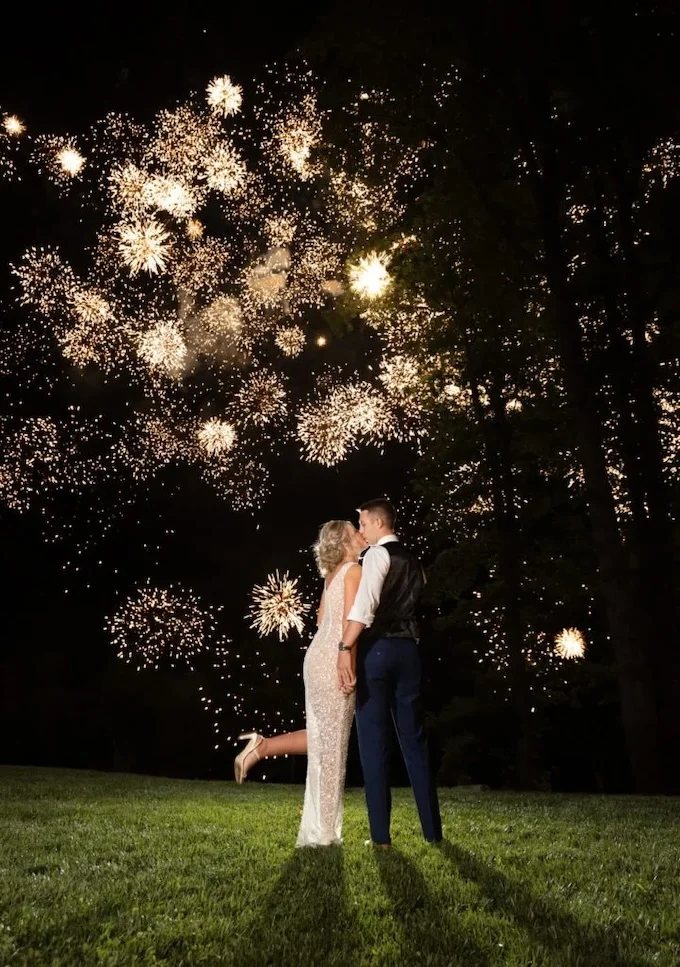
Fireworks, a spectacle typically associated with national holidays and grand celebrations, have found a surprisingly captivating niche in the world of event photography, particularly at weddings. Far beyond their traditional display at theme parks and sporting events, fireworks now offer photographers an extraordinary opportunity to create truly unique and epic couples portraits. This specialized skill requires a blend of traditional portraiture techniques and specific knowledge of capturing dynamic, fast-moving light. The brief window of opportunity, often lasting mere minutes, demands meticulous planning and precise execution to ensure that the fleeting beauty of a fireworks display is immortalized alongside the enduring love of a couple. This article delves into the essential tips and creative ideas for photographers aiming to capture the flash and excitement of a grand finale in their couples’ sessions, drawing on insights from seasoned professionals.

All images featured in this article are provided by the photographers at Wedding Maps and used with their explicit permission.
Mastering the Art of Fireworks Photography for Couples Portraits
The ephemeral nature of fireworks—typically lasting between five to eight minutes, and often much shorter—underscores the critical need for efficiency and foresight in capturing compelling couples portraits against this dazzling backdrop. Success hinges on thorough preparation, ensuring photographers know precisely where to be and what steps to take when the moment arrives. The following guidelines are designed to equip photographers with the knowledge to navigate these challenges and produce stunning, memorable images.

Strategic Location Scouting: Finding the Perfect Vantage Point
When a wedding timeline includes a fireworks display, prompt communication with the couple, wedding planner, and venue is paramount. Early identification of the fireworks launch site is crucial for scouting optimal locations. The "best" angle is subjective and depends on the desired photographic outcome. A wide-open area might be ideal for capturing the sheer scale of fireworks filling the sky, with the couple silhouetted against the spectacle. Alternatively, incorporating foreground elements like trees or buildings can add depth and frame the shot beautifully. The principle of strong composition is indispensable; therefore, dedicating time to scouting locations is a non-negotiable step in the planning process.
Maximizing Dynamic Range: The Power of RAW and Precise Exposure
Photographing fireworks presents a significant lighting challenge: a dark ambient environment juxtaposed with intensely bright, potentially overexposed fireworks. To preserve intricate details in both the shadows of the scene and the highlights of the pyrotechnics, capturing images in RAW format is imperative. RAW files offer unparalleled flexibility in post-production for recovering details that would be lost in the compressed data of JPEG files.

RAW Files vs. JPEG: Unlocking Post-Production Potential
The distinction between RAW and JPEG formats is critical in high-contrast scenarios like fireworks photography. RAW files retain all the unprocessed sensor data, providing a significantly wider dynamic range. This means photographers have a greater ability to adjust exposure, recover shadow detail, and manage highlights without introducing artifacts or degrading image quality. JPEG files, on the other hand, undergo in-camera compression, discarding much of this data, which severely limits post-processing capabilities. For images where retaining every nuance of light and color is paramount, shooting in RAW is the professional standard.
Exposure Settings: A Starting Point for Success
Establishing the correct exposure is a delicate balance. While specific settings will vary based on camera model, lens, and ambient light conditions, a recommended starting point for aperture priority mode might be an f-stop of f/8 or f/11, a shutter speed of 1-2 seconds, and an ISO of 100. This combination aims to achieve a deep depth of field to keep the couple sharp while allowing sufficient light to enter the camera to capture the fireworks’ trails.

Crucially, photographers must leverage their camera’s histogram. This visual representation of tonal distribution is essential for preventing clipped highlights (data bunched up on the far right of the graph, indicating blown-out detail) and crushed blacks (data bunched up on the far left, indicating pure black with no detail). The goal is to position the histogram to capture the widest possible range of tones without losing critical information in either the brightest or darkest areas of the scene.
Harmonizing White Balance: Achieving Cohesive Color
Setting the white balance appropriately is key to ensuring that the colors of the fireworks and the couple’s skin tones appear natural and pleasing. A starting point of "Tungsten" white balance is often effective for fireworks, as it tends to render the artificial light of the explosions with a cooler, more accurate tone. If additional lighting is being used on the couple, such as a flash with a CTO (Color Temperature Orange) gel, adjusting the white balance to approximately 3200 Kelvin can help synchronize the artificial light with the ambient conditions. This setting can then be fine-tuned to achieve the photographer’s artistic vision for the final image.

Selecting the Right Lens: Versatility and Vision
The choice of lens is dictated by the desired composition and the shooting environment. A wide-angle lens is excellent for capturing the grandeur of the fireworks alongside the couple, encompassing a broad field of view. However, when working at a distance to achieve this, communication with the couple can become challenging. If the shooting space is limited, a zoom lens might be necessary to achieve a tighter shot. Paradoxically, a zoom lens can also be advantageous for creating a compressed perspective, making the fireworks appear larger and more impactful within the frame. Ultimately, a wide-angle lens often provides the most flexibility, allowing for a wider shot that can be cropped in post-production if a tighter composition is preferred.
Embracing Long Exposures: Painting with Light
To effectively capture the light trails and the full bloom of fireworks, photographers will invariably need to employ slower shutter speeds. Long exposures, typically ranging from 5 to 10 seconds, allow the camera to record the movement of light across the sky, creating dynamic streaks and patterns. Shorter exposures, between 2 and 5 seconds, will capture more distinct bursts but with less emphasis on motion.

The use of a tripod is absolutely essential when shooting with long exposures to prevent camera shake and ensure sharp images. Furthermore, employing a cable release, remote trigger, or the camera’s built-in delay timer (a 2-second delay is usually sufficient) will further minimize any vibration caused by pressing the shutter button, ensuring the integrity of the long exposure.
Illuminating Your Subjects: The Art of Flash and Ambient Balance
Unlike standard fireworks photography, where subjects are often secondary or absent, couples portraits demand careful attention to lighting. The goal is to balance the ambient light from the fireworks with controlled artificial light on the subjects. Ideally, the setup of lighting can be finalized before the fireworks begin, allowing for precise adjustments.

Photographers should approach lighting the couple as they would for any other portrait session. The flash should be positioned off-camera, typically at a 45-degree angle to the couple and slightly from above, mimicking natural light fall-off. A backlight can be added to create separation and define the subjects’ silhouettes against the dark sky. Modifiers such as snoots or grids can be used to concentrate the light precisely on the couple, preventing spill onto the background and maintaining the focus on their interaction. The specific lighting scheme will, of course, depend on the photographer’s creative vision and the desired mood of the portrait.
The Necessity of Manual Focus: Eliminating Autofocus Frustration
Autofocus systems can struggle in low-light, high-contrast environments like those created by fireworks. Relying on autofocus can lead to missed shots or out-of-focus subjects. Therefore, switching the lens to manual focus is a critical step. Utilizing the camera’s live view feature to meticulously focus on the couple—either by pre-focusing before the fireworks begin or by having an assistant assist—is recommended. Once focus is achieved, it’s crucial to lock it in and avoid any further adjustments during the fireworks display.

The Art of the Composite: Layering for Perfection
For photographers seeking ultimate control over the final image, creating a composite offers a powerful solution. This technique involves capturing a well-lit, perfectly posed portrait of the couple separately from the fireworks display. A sturdy tripod is indispensable for this method, as it ensures consistent framing between the subject shots and the fireworks shots.
Streamlining with Lightroom
The post-processing workflow for a composite begins in editing software such as Adobe Lightroom. It is vital to edit all the images intended for the composite in a consistent manner. A time-saving approach is to meticulously edit the portrait of the couple first, then synchronize these edits across all the fireworks images that will be used. This ensures a cohesive look and feel for the final composite.

Assembling in Photoshop
The next step involves importing the edited images into Adobe Photoshop and stacking them within a single document. By setting the blend mode of the fireworks layers to "Lighten," the brightest pixels—which correspond to the fireworks—will be revealed, effectively layering the explosions over the couple’s portrait. Layer masks can then be used to refine the composition, selectively revealing or concealing parts of each layer to achieve a seamless and dramatic final image.
Beyond the Grand Finale: Capturing Sparkler Moments
While not technically large-scale fireworks, sparklers are a popular addition to wedding celebrations, often featured during grand exits. Their inclusion in couples’ sessions warrants specific photographic considerations.

The Advantage of Larger Sparklers
When advising couples on sparkler selections for photography, recommending 36-inch sparklers over the more common 10-inch variety is a practical tip. The extended burn time of larger sparklers provides photographers with a more generous window to pose subjects, capture multiple shots, and allow for more elaborate light painting or writing with the sparklers.
Adjusting ISO and Aperture for Dim Light
Sparklers provide a relatively weak light source, necessitating adjustments to camera settings to compensate. Photographers can either supplement with artificial light or optimize their settings for the dim conditions. Whether the subjects are moving or stationary, increasing the ISO and using a wider aperture (a lower f-number) are initial steps to achieve a brighter exposure.

Settings for Moving Subjects
For dynamic shots with moving subjects, a starting point might include an aperture of f/2.8, an ISO of 800, and a shutter speed of 1/50th of a second. These settings aim to freeze motion while capturing sufficient ambient light and the sparkler’s glow.
Strategies for Static Subjects
When subjects are holding still, photographers can afford to use lower shutter speeds, perhaps in the range of 1/15th to 1/30th of a second, allowing more light to enter the sensor and create a richer image. The aperture and ISO would then be adjusted to complement the shutter speed, ensuring proper exposure and depth of field.

Safety First: The Indispensable Safety Bucket
Handling sparklers inherently involves working with fire. It is paramount for photographers to have a substantial bucket of water readily accessible. This serves as a safe and immediate disposal point for spent sparklers, mitigating any fire hazards and ensuring the safety of the couple and the surrounding environment.
Conclusion: Illuminating Love Stories with Explosive Backdrops
The art of photographing couples amidst fireworks, or the more intimate glow of sparklers, is a specialized skill that combines technical proficiency with creative vision. By meticulously planning, understanding camera settings, and mastering lighting techniques, photographers can transform fleeting moments of pyrotechnic brilliance into enduring visual narratives of love and celebration. The images captured are not merely photographs; they are testaments to unique moments, frozen in time, against a backdrop of spectacular light.

The following collection of images offers further inspiration, showcasing diverse approaches and stunning results achieved by talented photographers. These examples serve as a valuable resource for anyone looking to elevate their couples’ portraiture by incorporating the breathtaking drama of fireworks.
The professional execution of these techniques not only results in visually striking images but also contributes to the overall narrative of a wedding day, adding a layer of unforgettable magic and excitement. The careful orchestration of light, subject, and environment ensures that these extraordinary moments are preserved for a lifetime.