The rapid proliferation of generative artificial intelligence has fundamentally altered the velocity of visual content creation, reducing the time required to move from concept to draft from days to seconds. Today, a marketing professional can utilize prompt-based tools to generate a dozen aesthetic directions during a single morning briefing, while design teams can iterate on backgrounds, lighting, and crops without the traditional overhead of reshoots or manual masking. However, as the barrier to entry for high-quality image generation collapses, a critical secondary challenge has emerged: the distinction between a visually appealing image and a "commercial-ready" asset. In an era where volume is no longer the primary constraint, the industry is shifting its focus toward the legal, technical, and strategic viability of the images being deployed.
The New Creative Bottleneck: Production vs. Governance
Historically, the primary constraint in visual marketing was production capacity. Campaigns were limited by the physical realities of hiring photographers, securing locations, and managing lengthy post-production cycles. The advent of digital stock photography in the late 20th century mitigated these burdens, providing a repository of professionally licensed content. Generative AI (GenAI) has accelerated this trend further, yet it has created a new bottleneck centered on governance and selection.
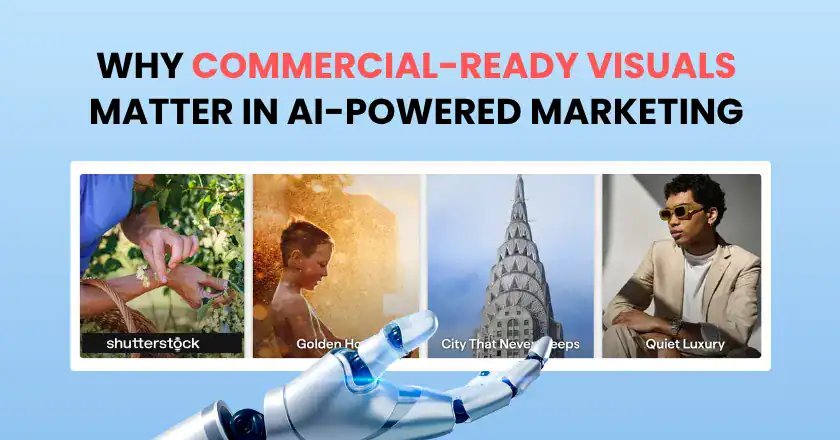
While AI can solve the "scarcity problem," it introduces a "provenance problem." For a visual to be considered campaign-ready, it must survive a rigorous gauntlet of requirements that extend far beyond its aesthetic value. This includes clear chain-of-title licensing, absence of intellectual property (IP) infringements, and technical scalability for multi-channel distribution. Industry analysts note that while 75% of marketing organizations now experiment with GenAI, only a small fraction have established the legal and operational frameworks necessary to move those experiments into public-facing, high-stakes commercial environments.
A Chronology of Visual Marketing Evolution
To understand the current urgency regarding commercial readiness, it is necessary to examine the timeline of visual production technology:
- The Physical Production Era (Pre-1990s): Marketing was defined by bespoke photography and illustration. Every campaign required a custom shoot, leading to high costs and slow turnaround times.
- The Digital Stock Revolution (1990s–2010s): The rise of agencies like Shutterstock democratized access to professional visuals. Marketers could license pre-cleared content, significantly reducing costs and allowing for faster campaign cycles.
- The Generative AI Explosion (2021–2023): The release of DALL-E, Midjourney, and Stable Diffusion introduced the ability to create "synthetic" content. This period was marked by rapid experimentation but also significant legal ambiguity regarding copyright and model training data.
- The Enterprise Integration Era (2024–Present): Companies are now integrating AI into established workflows. The focus has shifted from "Can we make an image?" to "Can we legally and safely use this image globally?" This has led to partnerships between AI developers and stock agencies to ensure "ethical AI" trained on licensed datasets.
Defining the "Commercial-Ready" Standard
The threshold for a commercial-ready visual involves four primary pillars: legal safety, technical integrity, brand consistency, and cultural relevance.

Legal Safety and IP Indemnification
A primary risk with many consumer-grade AI tools is the potential for "accidental infringement." This occurs when an AI generates a visual that inadvertently includes a trademarked logo, a protected architectural design, or the likeness of a person without a model release. Professional stock platforms have countered this by offering "commercially safe" AI generators. For example, Shutterstock’s AI tools are trained on licensed imagery, allowing the platform to provide indemnification to users—a crucial requirement for enterprise-level legal departments.
Technical Integrity and Scalability
A visual that looks acceptable on a smartphone screen may fail when scaled for a high-resolution billboard or a 4K display. Commercial readiness requires assets to be available in high-resolution formats with appropriate color profiles (CMYK for print, RGB for digital). AI-generated images often suffer from "artifacts"—subtle glitches in anatomy or texture—that require professional human intervention to correct before they are suitable for high-value placements.
Brand Coherence
Generative AI is notoriously prone to "style drift." A team may generate ten images that are individually beautiful but collectively incoherent. Maintaining a brand’s visual identity—its specific lighting style, color palette, and emotional tone—remains a significant challenge for purely synthetic workflows.

Supporting Data: The Economic Impact of Visual Readiness
Market research indicates that the demand for visual content is increasing by approximately 300% annually as brands move toward hyper-personalized advertising. However, the cost of "unready" content can be staggering. A 2023 survey of creative directors found that nearly 40% of their time is now spent "fixing" or "vetting" AI-generated assets to meet brand and legal standards.
Furthermore, data from performance marketing campaigns suggests that "authentic" imagery—visuals that feature real people in real environments—continues to outperform purely synthetic imagery in sectors like travel, food, and healthcare by as much as 22% in click-through rates (CTR). This data underscores the reality that while AI can generate volume, professional photography remains the benchmark for trust and engagement.
The Hybrid Workflow: Stock Media as "Raw Material"
The industry is moving toward a hybrid model where professional stock content serves as the "source code" for AI-assisted adaptation. In this workflow, a marketer begins with a high-quality, pre-cleared stock image. They then use AI tools to expand the background (outpainting), swap out products, or adjust the lighting to match a specific campaign theme.

This approach offers the best of both worlds: the legal and technical certainty of a professionally produced asset combined with the flexibility of generative technology. Platforms like Shutterstock have leaned into this by offering exclusive discounts and specialized products. Currently, marketers can utilize Shutterstock coupon codes to receive a 15% discount on any image product, including subscriptions and image packs. For those requiring specific volumes, there are exclusive 25% discounts available on 25-image packs, providing a cost-effective way to secure the "raw material" needed for AI-augmented campaigns.
Statements and Industry Reactions
"The goal is no longer just speed; it is ‘safe speed,’" says one senior creative technologist at a global advertising holding company. "We can generate a thousand images an hour, but if we can’t clear them through our legal team in ten minutes, the speed is an illusion. We need platforms that provide a ‘clean’ supply chain for our visuals."
Legal experts have also weighed in, noting that the U.S. Copyright Office has been hesitant to grant copyright protection to purely AI-generated works. This creates a strategic risk for brands: if a competitor can freely use your campaign imagery because it isn’t copyrightable, the brand’s competitive advantage is eroded. By using a hybrid approach—combining human photography with AI editing—brands can better secure their intellectual property.

Broader Impact: The Future of the Visual Economy
As AI becomes a standard feature in creative suites, the role of the professional creator is evolving from a "maker" to a "curator and director." The value of a professional stock library is increasing because it provides the "ground truth" data that makes AI outputs believable and usable.
Moreover, the global nature of modern marketing adds another layer of necessity for commercial readiness. A campaign launched in multiple jurisdictions must account for varying local laws regarding the "right of publicity" and cultural sensitivities. Large-scale stock agencies provide curated collections that are already vetted for these nuances, saving international teams months of localized research.
Conclusion: The Enduring Value of the Human Eye
The future of visual marketing is not a zero-sum game between human creativity and artificial intelligence. Instead, it is an ecosystem where "commercial readiness" is the currency. As the digital landscape becomes saturated with infinite, effortless imagery, the value of the deliberate, the licensed, and the technically perfect will only rise.

For brands, the message is clear: the tools used to create an image are less important than the rights and quality attached to it. In a world of AI-powered marketing, the most important creative decision a brand can make is ensuring that its visuals are truly ready for the world to see. By leveraging professional foundations—such as those found in curated stock libraries—and augmenting them with AI, companies can achieve the scale they desire without the risks they cannot afford.