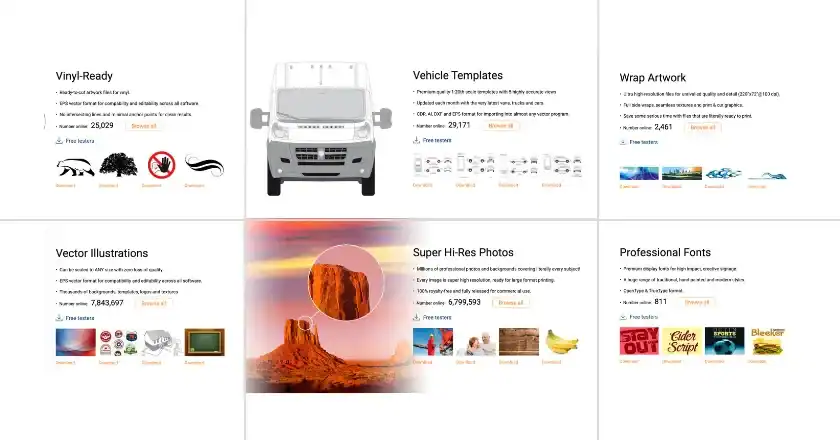
The digital content landscape has undergone a radical transformation over the last decade, evolving from a niche requirement for advertising agencies into a fundamental necessity for businesses of all sizes. Central to this evolution is the stock photography industry, where Depositphotos has established itself as a primary intermediary between global contributors and content creators. As of 2025, the platform serves as a repository for over 300 million files, encompassing high-resolution photographs, vector illustrations, and complex video footage. Understanding the financial and structural nuances of Depositphotos’ pricing models is essential for organizations seeking to optimize their creative budgets while maintaining high aesthetic standards.
The Strategic Positioning of Depositphotos in the Global Market
Founded in 2009 and headquartered in New York, Depositphotos was established with the goal of bridging the gap between high-end, expensive stock agencies and the burgeoning demand for affordable, high-quality digital assets. The company’s growth trajectory was marked by a significant milestone in October 2021, when it was acquired by Vista (formerly VistaPrint), a subsidiary of Cimpress, in a deal valued at approximately $85 million. This acquisition integrated Depositphotos into a broader ecosystem of design tools, including VistaCreate and 99designs, positioning it as a comprehensive solution for small business marketing.
Today, Depositphotos operates as a global marketplace, supporting 26 languages and serving a client base that exceeds 40 million users. Its library is fueled by a network of over 100,000 contributors, ranging from independent photographers to professional studios. This scale allows the platform to offer a highly competitive pricing structure that challenges industry incumbents like Getty Images and Shutterstock.
Historical Evolution and Growth Chronology
The development of Depositphotos’ pricing and service model can be traced through several key phases:

- 2009–2012 (The Entry Phase): Launch of the platform with a focus on aggressive pricing to gain market share. The company quickly reached the milestone of one million files within its first few years of operation.
- 2013–2017 (Expansion and Diversification): Introduction of specialized categories, including 4K video and a dedicated editorial section. During this period, the company shifted toward more flexible subscription models to cater to the rise of social media marketing.
- 2018–2021 (Technological Integration): Implementation of AI-driven search algorithms and the launch of mobile applications. The library surpassed 200 million assets, reflecting a surge in global contributor participation.
- 2021–Present (The Vista Era): Post-acquisition, the focus shifted toward "Creative-as-a-Service," integrating stock assets directly into design platforms and refining subscription tiers to maximize value for the Vista ecosystem users.
Analysis of Subscription Models and Cost-Per-Image Data
Depositphotos categorizes its pricing into two primary formats: monthly/annual subscriptions and on-demand credit packs. The subscriptions are designed for users with a recurring need for content, offering the lowest price point per asset.
Monthly and Annual Subscription Tiers
The subscription plans are tiered based on download volume, providing scalability for freelancers and large marketing departments alike. As of the current fiscal period, the following data represents the core image subscription offerings:
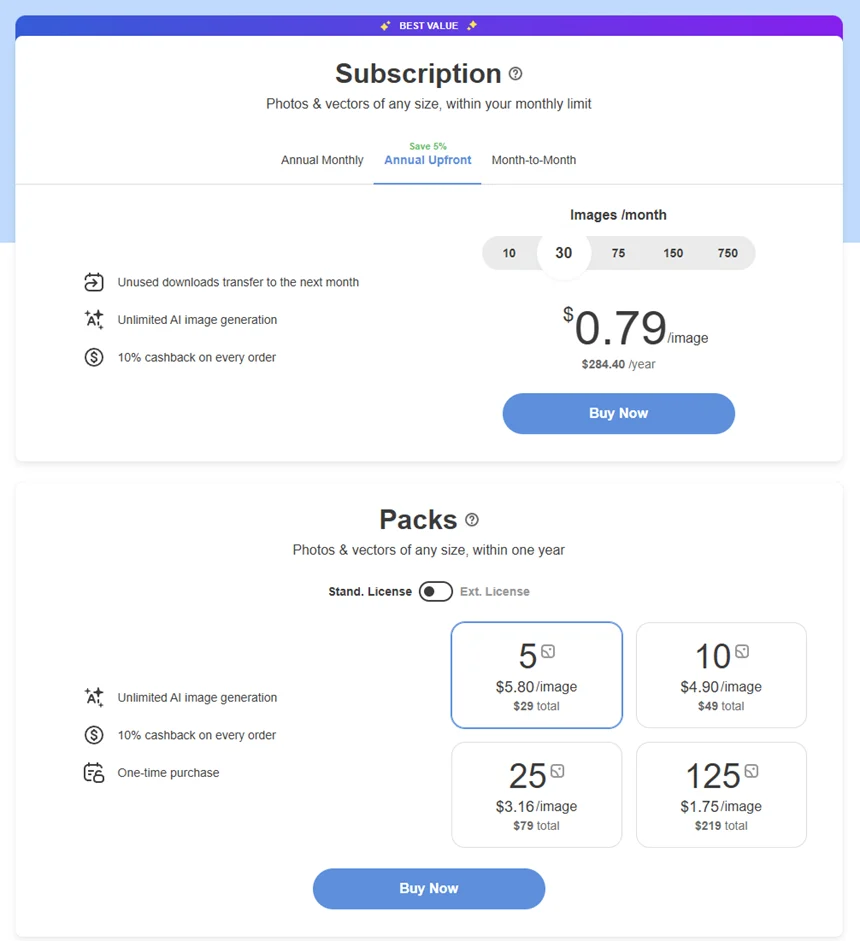
- 10 Images Plan: This entry-level tier is priced at $10.90 for a single month. For users opting for an annual commitment paid monthly, the price drops to $9.90. This results in a cost-per-image of approximately $0.99 to $1.09.
- 30 Images Plan: Positioned for small-scale projects, this plan costs $24.75 per month on a monthly billing cycle. When billed annually (paid upfront at $284.40), the effective monthly rate remains competitive, aimed at steady social media managers.
- 75 Images Plan: This mid-tier option is priced at $66.75 for monthly billing. The annual upfront cost of $621 reduces the effective monthly burden to $51.75, bringing the cost-per-image down to roughly $0.69.
- 150 Images Plan: Designed for active design teams, this plan costs $97.50 monthly. The annual upfront payment of $882 lowers the effective cost to $73.50 per month, or approximately $0.49 per image.
- 750 Images Plan: The highest volume standard plan is priced at $187.50 per month. Large enterprises paying $1,699 upfront for the year see their monthly effective rate drop to approximately $141.58. This offers the most significant economy of scale, with images costing as little as $0.18 each.
On-Demand Credit Packs
For users whose project timelines are irregular, Depositphotos provides "On-Demand" downloads. Unlike subscriptions, these downloads are valid for one year from the date of purchase.
- 10 Downloads: $49 (approximately $4.90 per image)
- 25 Downloads: $99 (approximately $3.96 per image)
- 100 Downloads: $299 (approximately $2.99 per image)
Data analysis suggests that while on-demand packs offer greater flexibility, the cost-per-unit is significantly higher—often four to five times the price of a high-volume subscription. This makes on-demand packs suitable only for infrequent users or those with highly specific, one-time project requirements.
Licensing Framework: Standard vs. Extended
A critical component of Depositphotos’ value proposition is its licensing structure. Every subscription and credit pack includes a Standard License. This allows for the use of images in advertising, marketing, apps, websites, and printed materials with a print run of up to 500,000 copies.

However, for commercial products intended for resale (such as t-shirts, mugs, or web templates), an Extended License is required. The pricing for Extended Licenses is separate from standard subscriptions:
- 1 Extended License: $89.00
- 5 Extended Licenses: $359.00 ($71.80 each)
- 25 Extended Licenses: $1,599.00 ($63.96 each)
This tiered licensing ensures that professional merchandisers have a legal pathway to utilize high-quality imagery without the risk of copyright infringement, though at a higher capital entry point.
Technological Innovations and User Experience
The efficiency of a stock photo agency is not solely measured by price, but by the speed at which a user can locate the desired asset. Depositphotos has invested heavily in AI-powered search tools. The platform’s search engine utilizes machine learning to interpret complex queries, allowing users to filter by:
- Chromaticity: Searching for images that match a specific brand color palette.
- Composition: Filtering by orientation (horizontal, vertical, panoramic) and the presence of "copy space" for text overlays.
- Demographics: Advanced filters for the number of people in a shot, their age, gender, and ethnicity.
- AI-Generated Content: In response to the 2023-2024 AI boom, Depositphotos introduced an AI image generator, allowing users to create custom visuals when the existing library does not meet specific needs.
Competitive Landscape and Market Implications
When compared to industry leaders, Depositphotos occupies a "sweet spot" of affordability and quality. Adobe Stock, for instance, offers deep integration with Creative Cloud but often at a higher price point for comparable volume. Shutterstock remains a formidable competitor with a larger library, but Depositphotos’ annual "upfront" discounts often provide a lower barrier to entry for budget-conscious startups.
Industry analysts suggest that the continued consolidation of stock agencies—such as the Vista-Depositphotos merger—indicates a shift toward "all-in-one" marketing platforms. For the user, this means that the value of a Depositphotos plan is no longer just the image itself, but the integration with design tools like VistaCreate, which allows for immediate editing and publishing.

Corporate and Enterprise Solutions
For multinational corporations and large-scale agencies, the standard subscription tiers often fall short of organizational needs. Depositphotos addresses this through its Enterprise division. These bespoke plans offer:
- Multi-User Access: Sub-accounts with centralized billing and administrative controls.
- Custom Indemnification: Enhanced legal protection for high-profile global campaigns.
- Uncapped Downloads: Tailored high-volume access that exceeds the 750-image monthly limit.
- Dedicated Support: Personalized account management to assist in asset curation and licensing compliance.
These enterprise solutions are negotiated on a case-by-case basis, reflecting the specific risk profile and volume requirements of the client.
Broader Impact on the Creative Economy
The accessibility of platforms like Depositphotos has democratized high-quality design. Small businesses that once relied on low-quality amateur photography can now project a professional brand image for less than $10 a month. However, this shift has also pressured the contributor side of the economy. With prices per image dropping to as low as $0.18 in high-volume plans, photographers must rely on massive sales volumes to maintain profitability.
From a journalistic perspective, the pricing transparency of Depositphotos serves as a benchmark for the industry. By offering a clear breakdown of monthly versus annual costs, the platform forces competitors to maintain price discipline.
Final Assessment of Value
In summary, choosing the right Depositphotos plan requires a data-driven approach to one’s own content consumption. For a freelance social media manager, the 30-image monthly plan offers a balance of variety and low risk. For a mid-sized marketing agency, the 750-image annual plan represents the pinnacle of cost efficiency.

As the digital world moves toward more immersive and visual-heavy formats, the role of Depositphotos as a high-volume, low-cost provider appears secure. The integration of AI tools and the backing of the Vista ecosystem suggest that Depositphotos will remain a central pillar of the creative economy for the foreseeable future, providing the visual infrastructure upon which modern digital identities are built.