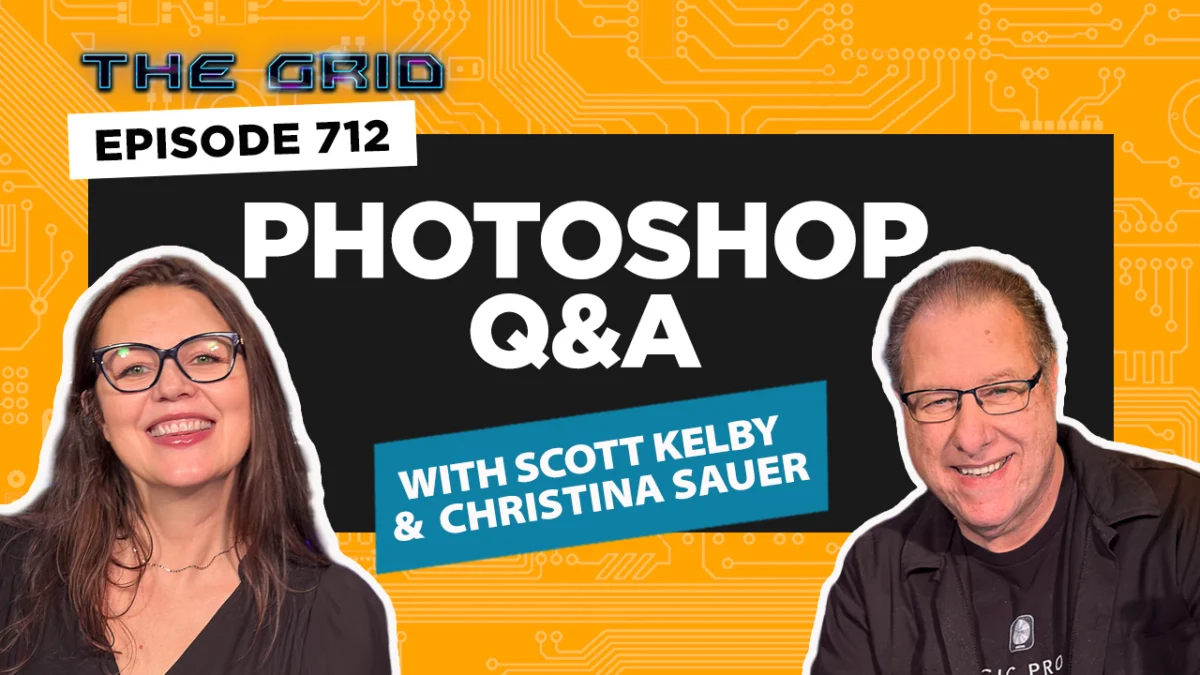
The latest installment of The Grid, episode 712, broadcast live this week, featured renowned photographer and educator Scott Kelby alongside KelbyOne producer Christina Sauer in an insightful Photoshop Q&A session. Engaging a lively studio audience and a global online viewership, the episode delved into critical considerations for digital photographers, particularly the nuanced decision-making process between Adobe Lightroom and Photoshop, and the rapidly evolving landscape of AI-powered editing tools. The discussion provided practical guidance on optimizing creative workflows, leveraging cutting-edge technology, and understanding the financial implications of advanced AI features, marking a significant contribution to ongoing dialogues within the professional photography community.
Navigating the Digital Darkroom: Lightroom Versus Photoshop
A central theme of the Q&A revolved around one of the most frequently posed questions by digital photographers: discerning when to remain within the efficient confines of Adobe Lightroom for image management and basic adjustments, and when to transition to the more granular, pixel-level control offered by Adobe Photoshop. This dilemma reflects the distinct architectural and functional philosophies behind Adobe’s flagship imaging applications, both of which hold dominant positions in the professional and enthusiast markets.
Lightroom, celebrated for its non-destructive editing environment, robust cataloging capabilities, and streamlined batch processing, excels at tasks such as exposure correction, color grading, lens profile corrections, and metadata management across large volumes of images. Its interface is designed for rapid iteration and consistent application of styles. Industry reports, including those from major photography surveys, consistently indicate that a significant majority of professional photographers initiate their post-production workflow in Lightroom or its cloud-based counterpart, Lightroom Classic, owing to its efficiency in handling raw files and comprehensive organizational tools.
Conversely, Photoshop has long been the undisputed industry standard for intricate image manipulation, compositing, advanced retouching, and graphic design integration. Its layer-based architecture allows for unparalleled control over individual elements of an image, enabling complex masking, precise selections, content-aware filling, and sophisticated brushwork that are beyond Lightroom’s scope. Scott Kelby, drawing from decades of experience and extensive interaction with professional workflows, articulated his decision-making framework, emphasizing that Photoshop becomes indispensable when an image demands "more advanced cleanup or retouching." This typically includes tasks like removing distracting elements that are not easily addressed by Lightroom’s spot removal tools, complex skin retouching, object removal or addition, precise compositing of multiple images, or applying intricate special effects. The episode underscored that while Lightroom provides an excellent foundation, Photoshop serves as the ultimate problem-solver for pixel-perfect refinement and creative transformation.
The Ascent of AI in Image Editing: A Historical Perspective
The conversation seamlessly transitioned into a comprehensive exploration of Photoshop’s increasingly sophisticated AI-powered tools, highlighting how these innovations are redefining the boundaries of image manipulation. It is crucial to contextualize the current wave of AI integration within Adobe’s broader, long-standing commitment to artificial intelligence and machine learning, which predates the recent surge in public awareness around "generative AI."
Adobe’s journey with AI began many years ago, with features like "Content-Aware Fill," introduced in Photoshop CS5 in 2010, marking a significant early milestone. This tool, which intelligently fills selected areas with surrounding content, was an early precursor to the more advanced generative capabilities seen today. Subsequent iterations brought further AI enhancements, including "Face-Aware Liquify" (2016) for intuitive facial adjustments, and "Select Subject" (2018) and "Object Selection Tool" (2020), which leverage machine learning to accurately identify and isolate subjects or objects within an image with remarkable precision. These foundational AI features, often operating subtly in the background, have gradually become integral to photographers’ workflows, automating previously tedious and time-consuming manual tasks.
The recent acceleration in AI development, particularly in the realm of generative AI, has introduced a new paradigm. Adobe has strategically integrated its Sensei AI engine, a proprietary framework, across its Creative Cloud suite. This strategic investment reflects a broader industry trend where AI is increasingly viewed not just as an enhancement, but as a transformative force capable of augmenting human creativity and dramatically improving efficiency. The global market for AI in creative applications has seen exponential growth, with projections indicating continued expansion as technologies become more sophisticated and accessible. Adobe’s commitment is further evidenced by its consistent announcements of new AI features at its annual MAX conferences, which frequently highlight user-centric innovations designed to streamline complex editing processes.
Spotlight on Photoshop’s Latest AI Innovations: Find Distractions
A key demonstration during The Grid episode focused on Photoshop’s "Find Distractions" feature, an exemplary illustration of current AI capabilities designed to address common photographic nuisances. This tool represents a significant leap forward in automated cleanup, capable of intelligently identifying and suggesting the removal of elements that detract from an image’s primary subject. Scott Kelby showcased its efficacy in eliminating various types of unwanted clutter, including wires, graffiti, vehicles, and other background elements that can compromise an image’s aesthetic integrity.
Traditionally, removing such distractions required meticulous manual cloning, healing, or painting, often consuming considerable time and demanding a high level of skill to achieve seamless results. "Find Distractions" automates much of this process, leveraging advanced image recognition algorithms to detect anomalies and propose targeted removals. This not only dramatically reduces editing time but also makes professional-level cleanup more accessible to a wider range of users, including those who may not possess extensive Photoshop expertise. The ability to quickly neutralize visual noise allows photographers to focus more on the creative aspects of their work, enhancing storytelling and visual impact.
Crucially, the demonstration also emphasized the importance of non-destructive editing practices even when employing powerful AI tools. Scott Kelby illustrated a simple, yet vital, technique for photographers to retain control over the AI’s output: the ability to non-destructively bring back any elements that the AI might have removed but were, in fact, desired. This involves working on duplicate layers, utilizing layer masks, or employing Smart Objects, ensuring that the original image data remains untouched. This approach provides a safety net, allowing for adjustments, refinements, or complete reversals of AI-generated edits without permanently altering the source material. This balance between automation and user control has been a recurring theme in user feedback channels and is critical for maintaining creative agency in an AI-augmented workflow.
Generative Credits and Resource Management
The discussion extended to the operational mechanics of some of Photoshop’s most advanced AI features, specifically addressing the concept of "generative credits." With the introduction of highly resource-intensive generative AI capabilities, such as Generative Fill and Generative Expand (which leverage large language models and vast datasets to create new image content), Adobe implemented a system of generative credits. These credits are consumed when users utilize specific generative AI functions that require significant computational power, often involving cloud-based processing.
Kelby and Sauer clarified the necessity of these credits, explaining that they manage the demand on Adobe’s extensive server infrastructure, which performs the complex calculations required for real-time image generation. While many core AI features, like "Find Distractions" or "Select Subject," typically do not consume credits, the more transformative generative tools do. Adobe provides a baseline allocation of credits with Creative Cloud subscriptions, with options to purchase additional credits for heavy users. This model reflects a broader industry trend for AI-as-a-service, where computational resources for complex AI operations are metered. Understanding the credit system is essential for photographers planning intensive generative AI projects, allowing them to manage their resources effectively and anticipate potential costs. This transparency regarding resource consumption helps users make informed decisions about when and how to deploy these powerful, yet computationally demanding, tools.
The Context of "The Grid" and KelbyOne
The insightful Q&A session is emblematic of the high-quality educational content consistently delivered by The Grid, a long-running and influential weekly talk show dedicated to photography and Photoshop. Hosted by Scott Kelby, a globally recognized figure in photography education, publishing, and software training, the show has cultivated a loyal following since its inception. The Grid serves as a vital platform for disseminating practical techniques, discussing industry trends, and offering expert advice, making complex topics accessible to a broad audience ranging from aspiring enthusiasts to seasoned professionals.
KelbyOne, the overarching educational platform founded by Scott Kelby, stands as a cornerstone in the digital photography and creative arts education landscape. Offering an extensive library of online courses, tutorials, and resources, KelbyOne empowers creators worldwide to master their craft. Christina Sauer, as a producer for KelbyOne and a frequent co-host on The Grid, brings an additional layer of practical insight and a user-centric perspective to these discussions. Her role ensures that the content remains grounded in the real-world challenges faced by photographers, complementing Scott Kelby’s high-level strategic and technical expertise. The synergy between Kelby and Sauer, coupled with the interactive format of The Grid, creates an engaging and highly informative learning environment that directly addresses the evolving needs of the photographic community.
Implications for the Modern Photographer
The discussions on The Grid Episode 712 carry significant implications for the contemporary photographer, underscoring a fundamental shift in the landscape of digital imaging.
Enhanced Efficiency and Productivity: The most immediate impact of advanced AI tools is the substantial increase in workflow efficiency. Tasks that once required minutes or even hours of meticulous manual work can now be accomplished in seconds or a few clicks. This allows photographers to process more images, meet tighter deadlines, and dedicate more time to the creative aspects of photography, such as composition, lighting, and client interaction, rather than repetitive post-production chores. Industry analyses frequently cite improved efficiency as a primary driver for the adoption of AI-powered software in creative industries.
Evolution of Skillsets: The rise of AI necessitates an evolution in the photographer’s skillset. While fundamental photographic principles remain paramount, the emphasis in post-production is shifting from purely manual execution to critical evaluation and artistic direction of AI outputs. Photographers must develop an eye for discerning when AI has delivered a desirable result, when it needs refinement, and how to effectively guide the AI to achieve specific creative visions. This involves understanding the capabilities and limitations of these tools and mastering non-destructive techniques to maintain ultimate control. Educational platforms like KelbyOne are at the forefront of providing training tailored to these evolving demands.
Democratization of Advanced Editing: AI-powered tools are democratizing access to professional-level editing techniques. Complex tasks that once required years of Photoshop mastery, such as intricate object removal or seamless compositing, are now within reach of a broader audience. This lowers the barrier to entry for aspiring photographers and small businesses, enabling them to produce high-quality visuals without extensive technical training or outsourcing. This trend can foster greater creative expression across the board, though it also raises questions about the distinction between human-generated and AI-augmented artistry.
Ethical Considerations and Authenticity: While not explicitly detailed in the episode’s summary, the broader discussion around AI in photography invariably touches upon ethical considerations. The ease with which AI can alter or generate image content raises questions about authenticity, journalistic integrity, and the very nature of photographic truth. As AI tools become more sophisticated, the distinction between a captured reality and a generated or heavily manipulated image becomes increasingly blurred. This necessitates a heightened awareness among photographers and viewers alike regarding the provenance and integrity of images, prompting ongoing dialogues within professional organizations and media ethics bodies.
Future Outlook: Adobe’s relentless pursuit of AI integration signals a future where creative software is increasingly intelligent, intuitive, and assistive. The trajectory points towards even more personalized and context-aware editing experiences, where AI anticipates user needs and proactively suggests creative enhancements. This continuous innovation promises further efficiencies and expands the realm of creative possibilities, solidifying the role of AI as an indispensable partner in the modern digital darkroom.
In conclusion, The Grid Episode 712 provided a timely and essential resource for photographers navigating the complexities of modern digital imaging. Scott Kelby and Christina Sauer’s expert guidance on optimizing workflows between Lightroom and Photoshop, coupled with their insightful exploration of AI-powered tools like "Find Distractions" and the mechanics of generative credits, offered invaluable perspectives. The episode not only illuminated the practical applications of cutting-edge technology but also underscored the evolving skillset required for photographers in an increasingly AI-driven creative landscape, reinforcing KelbyOne’s commitment to empowering the global photographic community with relevant and forward-thinking education.