When my parents chose to move our small family from Saskatchewan to the remote Arctic and undertake the biggest adventure of our lives, we had to let go of certain comforts. Both my mother and father came from farming families and inherited the unyielding work ethic that serves as the backbone of Canada’s heartland. Still, we found joy in the simple pleasures afforded by society—easy access to family, mild summer evenings, and the predictable cycles of the seasons. Uprooting to the Arctic meant trading the familiar for the unknown, but I quickly found that the benefits of living closer to nature far exceeded what we left behind.
Since those early years, the best gifts in my life have always come from nature. After becoming a photographer, I used my camera to get closer to our wild kin. Wolves, penguins, lynx, sharks, and even the more elusive animals like spirit bears all became subjects of my lens. In my eyes, there is no greater privilege than living each day on a planet overflowing with more species and beauty than we could ever fully grasp. Of all the encounters I have shared with wildlife around the world, my experiences with whales, the true giants of Earth, have been some of the greatest gifts.
Challenging Perceptions of Marine Giants
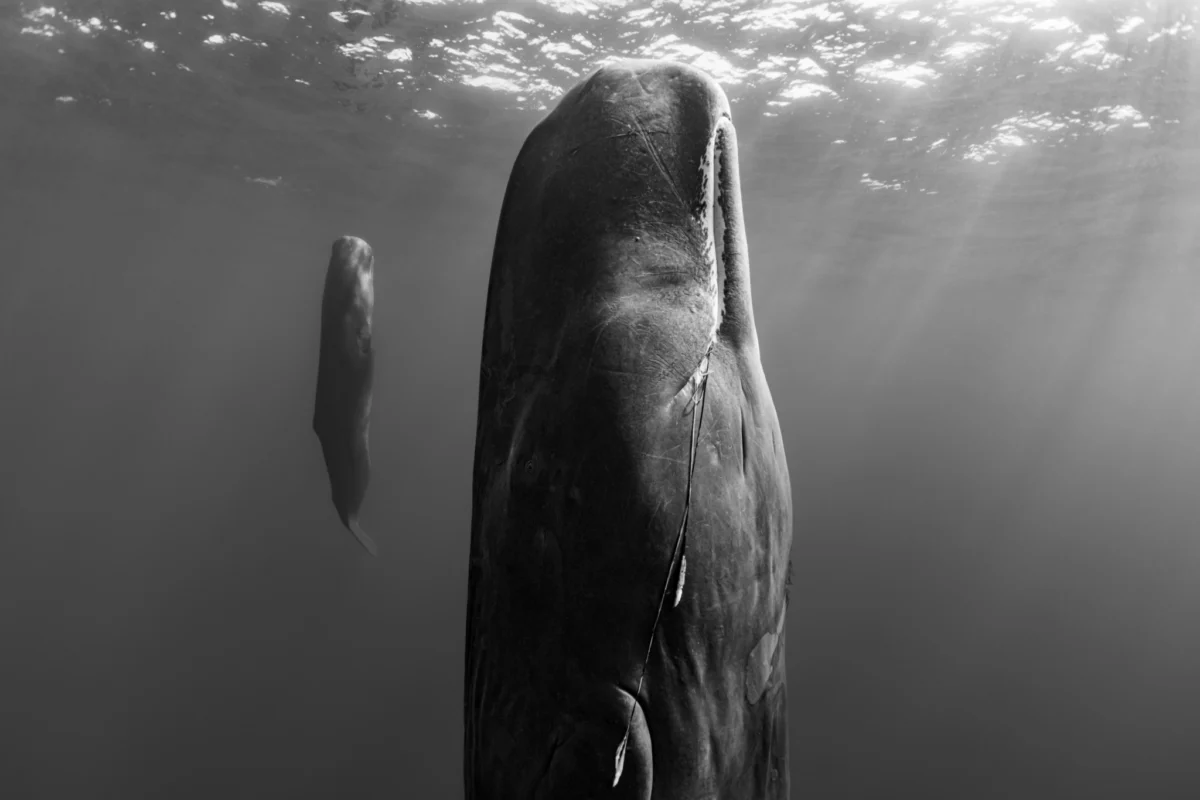
Like the Arctic wildlife I grew up with, such as wolves and polar bears, creatures like orcas and sperm whales inspire a mix of fear and awe in people. Despite their size and status as some of the ocean’s greatest hunters, there is no definitive record of orcas or sperm whales ever killing anyone. In fact, my own experiences have revealed their gentle nature and deep intelligence—a side that often goes unnoticed beneath the myths and misconceptions. Sperm whales, in particular, have garnered a reputation fueled in part by works of fiction, stories, and legends. Of all my encounters with whales, however, swimming with a pod off the coast of Dominica proved to be one of the most wholesome and eye-opening experiences of my life. Free-diving with a snorkel, I was able to get fairly close to a group dozing vertically in the water column. Sperm whales spend most of their time deep below the surface until they finally come up to breathe and rest, suspended with their heads pointed skyward.
The photographic session was proceeding with remarkable fluidity. The matriarch and her pod exhibited a profound sense of comfort and awareness regarding my presence, a testament to their innate intelligence and perhaps a learned acclimation to respectful human observation. This peaceful coexistence, however, was about to be punctuated by an unexpected, yet profoundly heartwarming, interaction. As I ascended to the surface for a much-needed breath, a sudden shift in the underwater dynamics drew my attention. The youngest member of the pod, a calf affectionately nicknamed "Ariel" by the local community, veered away from its mother and began a direct course towards me.
An Encounter with "Ariel"
What followed was a moment that vividly challenged preconceived notions about these colossal marine mammals. Ariel, a calf measuring approximately twenty feet in length, charged directly at me. My instincts, honed by years of working with large and unpredictable wildlife, prepared me for a potentially challenging encounter. However, instead of aggression, Ariel’s approach was marked by an astonishing display of innocent curiosity. As she drew nearer, her mouth opened—not to exhibit fearsome teeth, but to reveal a surprisingly gentle set of gums. In a moment that felt both surreal and deeply touching, the young whale began to playfully gum my camera housing, much like an inquisitive toddler exploring a new toy.
This interaction, far from being threatening, was a profound demonstration of Ariel’s inherent gentleness and burgeoning curiosity. It starkly contrasted with the fearsome image of the whale as a monstrous entity, a narrative often perpetuated by popular culture and historical accounts, most notably in Herman Melville’s "Moby Dick," which depicted the sperm whale as an implacable force of nature. Ariel, in her youthful exuberance, embodied a spirit of playful exploration, a stark reminder of the individual personalities and temperaments that exist within these magnificent species.
The encounter underscored a critical point: the majority of perceived danger associated with these animals stems from human projection and a lack of understanding, rather than from inherent predatory aggression towards humans. Scientific research and direct observation consistently support this, highlighting that while sperm whales are apex predators, their interactions with humans are overwhelmingly non-aggressive. Studies on sperm whale diet reveal a primary consumption of squid and fish, with no documented instances of humans being a prey item. The intelligence and complex social structures of sperm whales, evidenced by their intricate communication patterns and cooperative hunting strategies, suggest a capacity for discerning behavior rather than indiscriminate aggression.
The Arctic Roots of a Deep Connection
Looking back on my life, I realize that those early years of following in the footsteps of bears and foxes gave me the chance to connect even more deeply with Earth’s wildest creatures—like Ariel and her pod. The more time we spend immersed in nature, the more the world opens up to us with new experiences. Beyond any luxury or comfort that the fast pace of modern society can provide, nature offers us true connection.
The decision by my parents to relocate our family from the familiar prairies of Saskatchewan to the stark, remote beauty of the Arctic was a pivotal moment that irrevocably shaped my life’s trajectory. This move, undertaken in pursuit of a grand adventure, necessitated a significant departure from the comforts and conveniences we had previously known. My parents, both hailing from farming backgrounds, brought with them an ingrained, unyielding work ethic—a characteristic that forms the very bedrock of Canada’s agricultural heartland. Yet, despite the sacrifices, we discovered profound joy in the simpler pleasures that nature afforded: the easy accessibility of our extended family, the gentle embrace of mild summer evenings, and the comforting predictability of the changing seasons. This transition, from the known to the unknown, was a bold leap. However, it was a leap that rapidly revealed the immeasurable benefits of living in close proximity to the natural world, benefits that far surpassed anything we had left behind.

The initial immersion into the Arctic environment was a profound education. The stark, yet breathtaking, landscapes and the resilience of the wildlife that inhabited them instilled in me a deep respect for the natural world. My formative years were spent observing the intricate behaviors of animals like wolves and polar bears, creatures that exuded an aura of raw power and untamed spirit. These early encounters were not merely observations; they were foundational experiences that fostered an intimate understanding of the delicate balance of ecosystems and the interconnectedness of all living things.
The Photographer’s Lens: Bridging Worlds
It was this profound connection to nature that ultimately guided me toward a career as a wildlife photographer. My camera became an extension of my desire to document, understand, and share the wonders of the natural world. I sought to capture the essence of our wild kin, venturing to remote corners of the globe to photograph an array of species, from the iconic wolves and penguins to the elusive spirit bears. Each click of the shutter was an attempt to translate the awe and wonder I felt into a visual narrative, a testament to the planet’s extraordinary biodiversity.
The opportunity to photograph whales, these majestic leviathans of the deep, represented a pinnacle in my photographic journey. Their sheer size, their ancient lineage, and their enigmatic lives in the ocean’s depths held a particular fascination. My experiences with them have consistently been among the most rewarding and humbling of my career, offering insights into a world largely hidden from human view.
Dominica: A Sanctuary of Sperm Whales
The encounter with "Ariel" occurred off the coast of Dominica, an island renowned for its rich marine biodiversity and its status as a crucial breeding and feeding ground for sperm whales. This region has become a focal point for scientific research and responsible ecotourism, aiming to foster a greater understanding and appreciation of these magnificent creatures. The sperm whale population in the Caribbean, particularly in the waters around Dominica, is a subject of ongoing study by marine biologists and conservationists who are dedicated to tracking their movements, social structures, and reproductive patterns. Organizations such as the Dominica Sperm Whale Research Project have been instrumental in gathering data that contributes to global conservation efforts for this species.
Sperm whales ( Physeter macrocephalus) are the largest toothed whales and possess the largest brains of any animal on Earth. Their ability to dive to extraordinary depths, exceeding 2,000 meters, in search of their primary prey, giant squid, is a remarkable feat of biological adaptation. Their life cycle is characterized by complex social bonds, with females living in stable matriarchal pods, while males typically live solitary lives or in bachelor groups, only joining females for mating. The average lifespan of a sperm whale can exceed 70 years, underscoring their long-term presence and ecological significance within marine ecosystems.
The specific location of this encounter, the waters off Dominica, are recognized as a critical habitat. The island’s mountainous topography creates a deep underwater trench close to shore, providing the ideal conditions for sperm whales to rest and nurse their young. This geographical feature allows for relatively easy access for researchers and photographers, facilitating closer observation of their behavior. The historical context of human interaction with sperm whales is complex, marked by periods of intense whaling that significantly depleted their populations. Fortunately, international conservation efforts and the establishment of marine protected areas have led to a gradual recovery for many whale species, including sperm whales, though they still face threats from ship strikes, entanglement in fishing gear, and pollution.
Broader Implications: Conservation and Understanding
The encounter with Ariel serves as a powerful reminder of the critical importance of conservation efforts and the need to foster a deeper understanding of marine wildlife. The myths and misconceptions surrounding species like sperm whales can hinder conservation initiatives by perpetuating fear and discouraging respectful interaction. By sharing experiences that highlight their gentle nature and intelligence, we can help to shift public perception and encourage greater support for the protection of their habitats.
The implications of such encounters extend beyond individual experiences. They contribute to a growing body of anecdotal and scientific evidence that underscores the intelligence, social complexity, and emotional capacity of marine mammals. This understanding is vital for advocating for stronger marine protection policies, combating illegal fishing practices that threaten whale populations, and mitigating the impacts of climate change on ocean ecosystems.
The continued presence of these magnificent creatures in waters like those off Dominica is a testament to both their resilience and the effectiveness of dedicated conservation work. However, the challenges remain significant. Ongoing research into whale behavior, migration patterns, and the impact of human activities is crucial for informing effective conservation strategies. The story of Ariel, the playful calf, is not just a personal anecdote; it is a narrative that speaks to the broader imperative of coexistence and respect for the wild inhabitants of our planet.
And that, I believe, is the greatest gift of all.