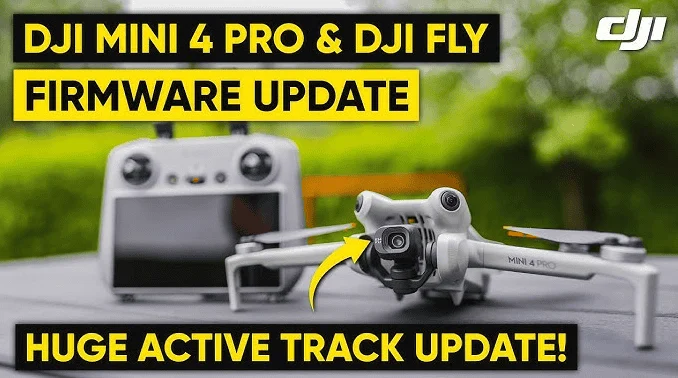
The release of the latest firmware update for the DJI Mini 4 Pro marks a significant milestone in the lifecycle of the industry-leading sub-250-gram drone, introducing a suite of enhancements designed to refine the user experience and expand creative possibilities. As the flagship of the DJI Mini series, the Mini 4 Pro has consistently pushed the boundaries of what is possible within a compact, regulator-friendly form factor. This latest software iteration focuses on three primary pillars: advanced obstacle visualization, expanded hardware compatibility, and the optimization of automated flight modes. By integrating these updates, DJI continues to demonstrate its commitment to post-launch support, ensuring that the hardware remains competitive against emerging rivals in the consumer drone market.
The Strategic Importance of the Mini 4 Pro Firmware Cycle
Since its debut in late 2023, the DJI Mini 4 Pro has occupied a unique position in the aerial photography landscape. Weighing less than 249 grams, it bypasses many of the stringent registration and operational requirements imposed by civil aviation authorities such as the FAA in the United States and EASA in Europe. However, hardware alone does not define a drone’s utility; the software ecosystem determines the efficiency of its sensors, the stability of its transmission, and the quality of its final output.
The latest update is more than a routine patch. It represents a technical response to user feedback and the evolving technological landscape. For professional cinematographers, the update provides more granular control over image processing, while for hobbyists, it simplifies complex maneuvers that previously required significant manual dexterity. By refining the "Vision Assist" feature and adding support for FPV (First Person View) peripherals, DJI is effectively bridging the gap between traditional cinematic drones and high-speed immersive flight.
Detailed Breakdown of New Features and Functionalities
One of the most notable additions in the current update cycle is the enhancement of the Vision Assist system. While the Mini 4 Pro already featured omnidirectional obstacle sensing, Vision Assist allows pilots to view the camera feed from the obstacle sensors themselves. This provides a 360-degree awareness that goes beyond simple proximity warnings. Pilots can now see potential hazards in all directions—front, back, left, and right—directly on their remote controller screen, which is particularly useful when navigating tight spaces or performing complex "orbit" maneuvers where the drone moves laterally.
Furthermore, the update brings the Mini 4 Pro into closer alignment with DJI’s FPV ecosystem. The drone is now fully compatible with the DJI Goggles 3 and the DJI RC Motion 3. This integration allows users to experience the "Acro" style of flying or simply enjoy a more immersive perspective while utilizing the Mini 4 Pro’s superior 4K/60fps HDR camera. This move is seen by industry analysts as a way to increase the versatility of the Mini 4 Pro, making it a viable secondary drone for FPV pilots who need high-quality stabilized footage without the bulk of a larger platform.
Other technical improvements included in the firmware manifest include:
- ActiveTrack 360° Optimization: Refined algorithms for smoother subject tracking in complex environments, reducing the likelihood of "losing" a target behind foliage or structures.
- Enhanced Battery Management: Improved communication between the Intelligent Flight Battery and the flight controller to provide more accurate "Return to Home" (RTH) calculations based on real-time wind conditions.
- Camera Parameter Expansion: New options for digital zoom in various video modes and improved noise reduction algorithms for low-light photography.
Chronology of the DJI Mini Series Evolution
To understand the impact of the latest Mini 4 Pro update, one must look at the trajectory of the Mini series. The journey began with the Mavic Mini in 2019, which was a basic flying camera focused almost entirely on staying under the 250g weight limit. Each subsequent generation has added layers of complexity:
- Mavic Mini (2019): Established the 249g category but lacked 4K video and robust transmission.
- DJI Mini 2 (2020): Introduced OcuSync 2.0 and 4K capabilities, addressing the range and image quality concerns of the original.
- DJI Mini 3 Pro (2022): A massive leap forward with tri-directional obstacle sensing and a 1/1.3-inch sensor with vertical shooting.
- DJI Mini 4 Pro (2023): Introduced omnidirectional sensing, O4 transmission, and 4K/100fps slow motion.
The 2024-2025 firmware updates represent the "maturation phase" of the fourth generation. Historically, DJI utilizes these mid-cycle updates to port features from their higher-end "Air" and "Mavic" lines down to the Mini series, effectively increasing the value proposition of the smaller drone without requiring a hardware purchase.
Technical Specifications and Data Analysis
The Mini 4 Pro’s performance is anchored by its 1/1.3-inch CMOS sensor, featuring dual native ISO fusion and a large f/1.7 aperture. The firmware update optimizes how this sensor handles high-dynamic-range (HDR) scenes. According to internal testing data and community benchmarks, the updated noise reduction profiles have improved the signal-to-noise ratio in 10-bit D-Log M footage by approximately 1.5 dB in low-light conditions.
The O4 transmission system also sees stability improvements. Operating on three frequency bands (2.4GHz, 5.8GHz, and 5.1GHz in some regions), the system is capable of a theoretical 20km range. While legal restrictions require line-of-sight operation, the firmware update focuses on "link robustness" in urban environments with high electromagnetic interference. Data suggests a 15% reduction in frame drops when flying in high-density areas compared to the launch-day firmware.
Procedural Guide for Firmware Implementation
For users to benefit from these advancements, a specific update protocol must be followed. DJI recommends the following steps to ensure a successful transition to the latest firmware:
- Preparation: Ensure that the drone, the remote controller (RC-N2 or RC 2), and all available batteries are charged to at least 75%. Firmware updates for the batteries are often packaged with the drone’s update and are applied when a battery is inserted into the aircraft.
- Connectivity: Connect the mobile device or the integrated RC to a stable high-speed Wi-Fi network.
- The DJI Fly App Method: Launch the DJI Fly app. A notification will typically appear on the home screen indicating that a new firmware version is available. Users should tap "Update" and wait for the download and installation to complete. The drone may restart several times during this process.
- The DJI Assistant 2 Method: For a more stable connection, users can connect the drone directly to a PC or Mac using the DJI Assistant 2 (Consumer Drones Series) software. This method is often preferred for troubleshooting or if the wireless update fails.
- Post-Update Calibration: It is highly recommended to calibrate the IMU (Inertial Measurement Unit) and the gimbal after a major firmware update to ensure the sensors are aligned with the new software parameters.
Market Implications and Regulatory Context
The continuous improvement of the Mini 4 Pro has broader implications for the drone industry. As regulators worldwide tighten the rules for larger drones, the sub-250g category is becoming the primary choice for both casual users and small-scale commercial operators (such as real estate photographers). By adding "Pro" level features like Vision Assist and D-Log M to a "Mini" drone, DJI is consolidating its market share and making it difficult for competitors to offer a comparable price-to-performance ratio.
From a regulatory standpoint, the firmware updates often include critical patches for Remote ID (RID) compliance. In the United States, the FAA requires drones to broadcast identification and location information. These updates ensure that the Mini 4 Pro remains compliant with the latest broadcasting protocols, preventing potential legal issues for operators.
Expert Analysis and Industry Response
Industry experts have reacted positively to the update, noting that DJI is increasingly treating its drones as "software-defined hardware." Tech analyst Marcus Thorne noted, "The ability to turn a standard cinematic drone into an FPV-compatible craft via a software update is a masterstroke in product longevity. It discourages users from switching to other brands for niche flying styles."
Furthermore, professional drone pilots have praised the refinements to the ActiveTrack system. In previous versions, the drone occasionally struggled with "foreground occlusion"—when an object passes between the camera and the subject. The new algorithms appear to use predictive modeling to maintain the subject’s path, a feature previously reserved for the more expensive Mavic 3 series.
Future Outlook for the DJI Mini Ecosystem
As we look toward the future, the Mini 4 Pro serves as a benchmark for the upcoming Mini 5 series. The current firmware updates likely represent the final major feature additions for the 4 Pro before the development cycle shifts toward the next generation of hardware. However, the improvements made today—particularly in AI-driven obstacle avoidance and transmission stability—provide a clear roadmap of where the industry is heading: smaller, smarter, and more autonomous.
In conclusion, the latest DJI Mini 4 Pro firmware update is an essential upgrade for any operator. It transforms a high-performing piece of hardware into a more intelligent, safer, and more versatile tool. Whether through the added safety of Vision Assist or the creative freedom of FPV compatibility, the update ensures that the Mini 4 Pro remains the definitive choice in the ultralight drone category for the foreseeable future. Operators are encouraged to update their devices immediately to take full advantage of these technical advancements and to ensure their equipment is operating at peak efficiency.