Waking before dawn aboard the SeaLegacy 1, a palpable sense of anticipation permeated the air as the expedition team prepared for what was to be the most eagerly awaited dive of their Pacific crossing from Mexico to Tahiti. Under the ethereal glow of a full moon illuminating a star-dusted sky, divers donned their gear, ready to descend into the inky blackness of the ocean depths. This was not just another dive; it was an immersion into one of the planet’s most extraordinary natural phenomena: the annual grouper spawning aggregation in the Fakarava atoll, a remote paradise renowned for its pristine lagoons and vibrant coral reefs.
Located approximately 700 nautical miles north of Papeete, Fakarava is a UNESCO Biosphere Reserve, a testament to its ecological significance. The atoll’s ecosystem is a complex tapestry of life, supporting a staggering diversity of species including numerous fish, seabirds, sea turtles, and majestic manta rays. However, it is during the warmer months that Fakarava transforms into a stage for an unparalleled display of nature’s reproductive drive, drawing in not only the target species but also a formidable congregation of predators.
The Prelude to the Feast: Grouper Gatherings
The genesis of this grand event lies in the migratory behavior of thousands of resident groupers. As the warmer waters signal the optimal time for reproduction, these fish, laden with eggs and sperm, converge at the mouth of the atoll’s main channel. This channel, a crucial nexus between the vast ocean and the sheltered lagoon, spans roughly 10 by 30 nautical miles. The unique tidal patterns of Fakarava, with the ocean’s deep, clear waters rushing into the lagoon for six-hour intervals before ebbing back out, play a pivotal role. This dynamic exchange not only facilitates nutrient dispersal but also creates the ideal conditions for the groupers’ reproductive efforts.

The aggregation intensifies as the full moon approaches, a celestial cue that synchronizes the spawning process. Females, heavy with eggs, and males, poised to fertilize them, are drawn to this specific location. They find refuge amongst the intricate coral heads, their natural camouflage providing a deceptive sense of security. The scene, from the perspective of the observing divers, is one of suspended animation: thousands of groupers, each seemingly anchored to its coral sanctuary, their large eyes cautiously tracking the movements of approaching predators. This delicate balance, however, is about to be shattered.
The Shark Armada: A Natural Cull in Action
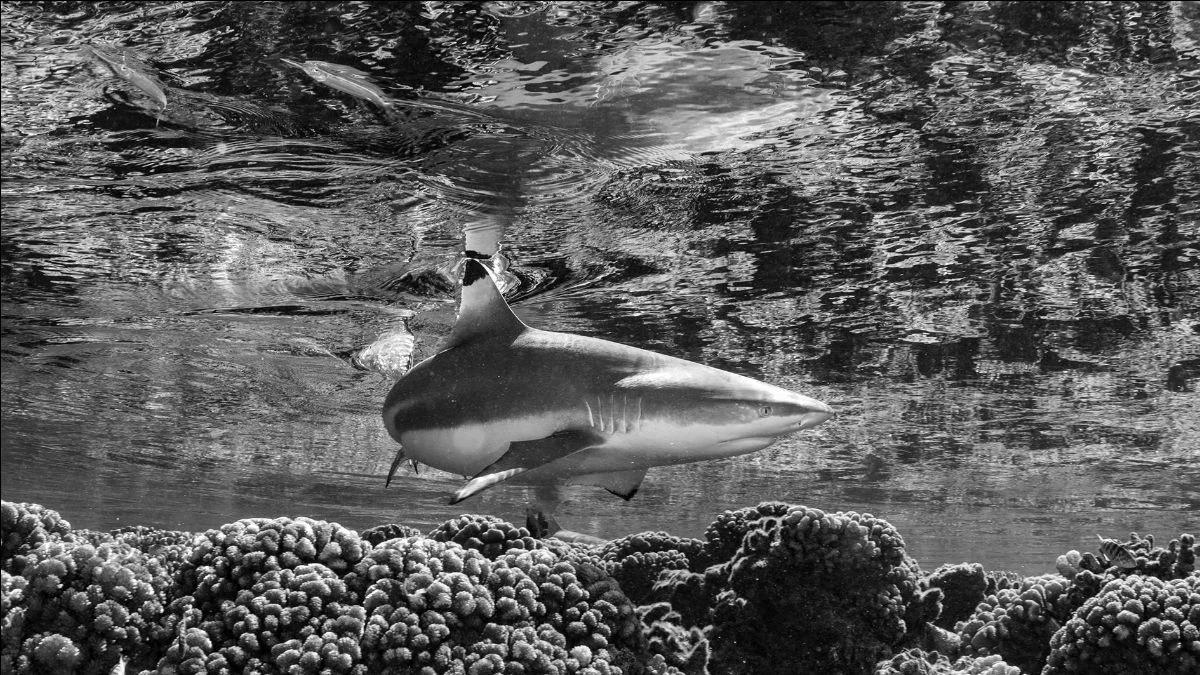
Following in the wake of the oblivious groupers is a formidable fleet of sharks. These apex predators, drawn by the concentrated food source, arrive in numbers that transform the normally serene waters into a scene of primal intensity. Reports from marine biologists studying similar spawning events in other regions, such as the Bahamas, indicate that aggregations can attract hundreds, and in some cases, even thousands, of sharks. This influx represents a critical phase in the ecosystem’s health, a natural selection process that has been refined over millennia.
The divers, positioned strategically at the edge of the atoll’s drop-off, observed this unfolding drama with a mixture of awe and trepidation. As they descended, the sheer volume of groupers became apparent, a silent army awaiting their moment. The initial quietude was periodically punctuated by the startling sound of a predator’s successful hunt, a sudden crunch echoing through the depths, followed by the chaotic thrashing of dozens of sharks converging on their prey. This served as a stark reminder of the intricate food web at play, where even the most well-camouflaged creatures are part of a larger, relentless cycle.
The Climax: A Frenzy of Life and Death
The apex of the spawning event occurs at the highest point of the tide, typically around the full moon. It is at this juncture that the groupers initiate their reproductive ritual. As females ascend to release their precious cargo of eggs into the water column, they are immediately surrounded by eager males, who release milt to fertilize the eggs. This synchronized release creates a cloud of genetic material, a vital act of perpetuation.

Simultaneously, the sharks, sensing the opportune moment, descend in a breathtaking, albeit brutal, display. The waters explode in a frenzy as hundreds of sharks vie for the nutrient-rich eggs and the vulnerable groupers themselves. The divers witnessed firsthand the raw power and efficiency of this natural phenomenon, a spectacle that is both awe-inspiring and deeply humbling. The scene, a testament to the complex interplay of predator and prey, is over in a matter of moments, leaving behind a transformed seascape.
Ecological Significance: More Than Just a Feeding Frenzy
The dramatic events at Fakarava, while appearing chaotic and even violent to human observers, are integral to the long-term health and stability of the marine ecosystem. Marine ecologists emphasize that such spawning aggregations are crucial for maintaining genetic diversity within fish populations and ensuring the continuation of species. Furthermore, the influx of predators plays a vital role in population control, preventing any single species from overwhelming the ecosystem.
Dr. Eugenie Clark, the renowned marine biologist and founder of the Mote Marine Laboratory, famously advocated for a profound shift in human perception of sharks. She urged observers to view these creatures not as threats, but as magnificent animals deserving of respect and admiration. "When you see a shark underwater, you should say, ‘How lucky I am to see this beautiful animal in his environment,’" she once stated. This perspective is crucial in understanding the role of sharks in Fakarava.
The consumption of eggs and vulnerable groupers by sharks is not merely predation; it is a form of nutrient redistribution. Sharks, as they move throughout the ocean, deposit nutrient-rich waste that fertilizes the coral reefs and supports a diverse array of marine life. This biological process, honed over millions of years, is essential for the vitality of the entire reef system. The presence of a healthy shark population is, therefore, a direct indicator of a thriving and balanced ecosystem.

The Imperative of Conservation: Protecting Our Living Oceans
The Fakarava atoll, with its extraordinary biodiversity and its role in supporting critical marine processes, stands as a powerful reminder of what is at stake in ocean conservation. The intricate ecological balance, from the smallest zooplankton to the largest sharks, has been shaped over millennia. Human activities, particularly overfishing and habitat destruction, pose significant threats to these delicate systems.
The narrative of Fakarava underscores a fundamental truth: humanity does not merely "learn to live with" sharks and other wildlife. Rather, our very existence is intrinsically linked to the health of these ecosystems. Sharks, and the vital roles they play, have been instrumental in maintaining the ocean’s equilibrium long before human intervention became a significant factor.
The photographic and videographic documentation of these natural spectacles, such as the work captured by Paul Nicklen and his team at SeaLegacy, serves a critical purpose. By sharing the wonder, drama, and inherent beauty of places like Fakarava, the aim is to foster a deeper appreciation for these wild and vital environments. This, in turn, is intended to galvanize local and global efforts to implement robust conservation measures, ensuring that these irreplaceable ecosystems are preserved for the benefit of future generations. The continued health of these marine sanctuaries is not just an environmental concern; it is a testament to our interconnectedness with the natural world and our responsibility to protect it.