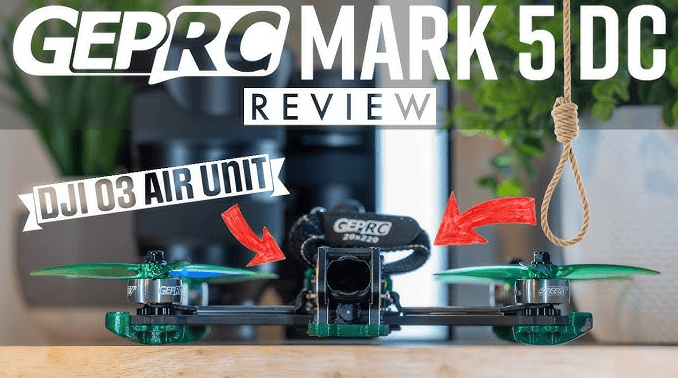
The evolution of First-Person View (FPV) drone technology has reached a pivotal juncture with the release of the GEPRC MARK5 DC HD O3 FPV, a platform that integrates high-end digital transmission with robust freestyle architecture. As the FPV industry transitions from specialized hobbyist builds to professional-grade cinematic tools, the MARK5 series represents a significant milestone in "Bind-and-Fly" (BNF) engineering. This drone is specifically designed to leverage the DJI O3 Air Unit, a component that has redefined the expectations for onboard recording and low-latency video transmission. By utilizing a "DeadCat" frame geometry, the MARK5 DC (DeadCat) addresses the historical challenge of propeller interference in high-definition video feeds, providing a clear field of view that is essential for professional aerial cinematography.
The Evolution of the MARK Series and Market Context
The GEPRC MARK series has long been regarded as a benchmark for durability and flight performance within the FPV community. The predecessor, the MARK4, established a reputation for a balanced center of gravity and ease of maintenance. However, the emergence of high-definition digital systems necessitated a redesign of the internal chassis to accommodate larger transmission units and heat management systems.
In late 2022 and throughout 2023, the introduction of the DJI O3 Air Unit created a demand for frames that could handle its unique dimensions and thermal output. GEPRC responded with the MARK5, utilizing a hybrid structure of T700 carbon fiber and 7075-T6 aircraft-grade aluminum alloy. This material choice reflects a broader trend in the industry toward "industrial-grade" consumer drones. Market data suggests that the shift toward integrated HD systems like the O3 has reduced the reliance on external action cameras, such as GoPros, thereby optimizing the drone’s weight-to-thrust ratio and extending flight times.
Architectural Design and Frame Geometry
The "DC" in the GEPRC MARK5 DC HD O3 FPV stands for "DeadCat," a frame configuration where the front arms are swept back and the rear arms are positioned further apart. This design serves a dual purpose. Primarily, it ensures that the propellers remain outside the 155-degree ultra-wide field of view of the O3 camera. For professional videographers, this eliminates the need for post-production cropping, preserving the full 4K resolution of the footage.
The frame itself is constructed from high-strength carbon fiber plates, with the main deck featuring a 2.5mm thickness and the arms utilizing 5mm thickness for maximum rigidity. The inclusion of CNC-machined aluminum side plates serves as a protective roll cage for the camera and the flight stack. This "structural exoskeleton" approach is a direct response to the high-velocity impacts common in freestyle flight. Analysis of crash-test data from independent pilot reviews indicates that the 7075 aluminum alloy components significantly reduce the likelihood of camera damage, which is a critical consideration given the high cost of the DJI O3 optics.
Technical Specifications and Propulsion System
The performance of the MARK5 is anchored by its sophisticated electronic stack and propulsion hardware. The drone is typically equipped with the GEP-F722-45A AIO (All-In-One) flight controller or a dedicated F7 stack, providing ample processing power for the latest Betaflight firmware features.
- Propulsion: The drone utilizes SPEEDX2 2107.5 motors, with a KV rating (typically around 1960KV for 6S configurations) optimized for 5-inch propellers. These motors are engineered with high-temperature resistant coils and N52H curved magnets, which improve torque and efficiency.
- Electronic Speed Controller (ESC): A 45A BLHeli_32 ESC provides precise current management, allowing for rapid motor RPM changes. This responsiveness is vital for "prop wash" handling and maintaining stability during aggressive maneuvers.
- Digital Transmission: The DJI O3 Air Unit is the centerpiece of the system. It features a 1/1.7-inch CMOS sensor capable of recording 4K/60fps video at a 130Mbps bitrate. The system supports the D-Cinelike color profile, which provides professional color graders with the dynamic range necessary for high-end production.
Thermal Management and Sustained Performance
One of the primary technical challenges of the DJI O3 Air Unit is its tendency to overheat when the drone is stationary or flying in high-ambient-temperature environments. GEPRC addressed this by integrating an active cooling strategy within the MARK5 frame. The placement of the O3 unit allows for maximum airflow through the center of the chassis. Furthermore, the aluminum components of the frame act as a secondary heat sink, dissipating thermal energy away from the sensitive internal processors.
Field reports from operators in tropical climates indicate that the MARK5 maintains signal stability and recording integrity even during back-to-back battery cycles, provided the drone remains in motion. This thermal efficiency is a key differentiator for commercial operators who require reliability during long shooting days.
Operational Protocols for Professional and Intermediate Pilots
While the GEPRC MARK5 DC HD O3 FPV is marketed as a versatile platform, its high power-to-weight ratio necessitates a specific operational protocol. Industry experts recommend a 6S LiPo battery setup, specifically 1300mAh to 1500mAh capacities, to achieve the optimal balance between flight agility and duration.
- Cinematic Flight: For videography, the use of Neutral Density (ND) filters is considered mandatory. These filters allow the camera to maintain a 180-degree shutter rule (e.g., 1/120th of a second for 60fps), resulting in natural motion blur that mimics high-end cinema cameras.
- Freestyle and Durability: For pilots focused on acrobatics, the MARK5’s "Propeller-in-View" (X-frame) variant is often preferred for its symmetrical physics, but the DC version remains highly capable. The software tuning (PID tuning) provided by GEPRC out of the box is generally optimized for "smooth-follow" characteristics, though it can be adjusted for snappier response times.
Economic and Industry Impact
The release of the MARK5 DC HD O3 has had a measurable impact on the FPV market ecosystem. By providing a pre-built, professionally tuned drone that rivals the quality of custom-built "boutique" rigs, GEPRC has lowered the barrier to entry for production houses and independent filmmakers.
According to market analysis, the "Ready-to-Fly" (RTF) and "Bind-and-Fly" (BNF) sectors have seen a 25% increase in adoption by non-hobbyist commercial entities over the past 24 months. The GEPRC MARK5 is frequently cited in equipment manifests for automotive commercials, real estate tours, and action sports coverage. The ability to capture "hero shots" in 4K without the aerodynamic penalty of a secondary camera has streamlined workflows and reduced the insurance risks associated with flying heavier, more complex payloads.
Safety and Regulatory Compliance
As FPV drones like the MARK5 gain popularity, regulatory bodies such as the FAA (Federal Aviation Administration) in the United States and EASA (European Union Aviation Safety Agency) have increased oversight. The MARK5, while a high-performance machine, must be operated within the legal frameworks of Remote ID and visual line-of-sight (VLOS) requirements. GEPRC has designed the frame to accommodate various GPS modules and Remote ID broadcast hardware, ensuring that professional operators can remain compliant with evolving national laws.
Conclusion and Future Outlook
The GEPRC MARK5 DC HD O3 FPV stands as a testament to the rapid maturation of FPV technology. It successfully bridges the gap between a rugged freestyle "basher" and a precision cinematic instrument. By integrating the DJI O3 system into a frame that prioritizes both structural integrity and visual clarity, GEPRC has provided a tool that meets the rigorous demands of modern content creation.
Looking forward, the industry anticipates further miniaturization of HD units and even higher integration of AI-assisted flight modes. However, the core fundamentals of the MARK5—high-quality carbon fiber, efficient propulsion, and intelligent geometry—remain the gold standard. For the professional pilot, the MARK5 is not merely a drone; it is a reliable aerial platform capable of delivering world-class imagery in the most challenging environments. As digital systems continue to evolve, the MARK5 architecture provides a future-proof foundation for the next generation of FPV aviation.